NC Senate candidate’s marijuana-biz texting partner irritates California activist

Being in the marijuana revenue policy business, I subscribe to a California marijuana newsletter put out by Brett Stone, an activist who has provided me (and others) a lot of useful information over the years.

Here’s an opinion piece he just posted about the North Carolina Senate race, with the title “DPFCA_NEWS: California cannabis strategist Arlene Guzman Todd caught up in NC Democratic Senate candidate sexting and sexual relationship scandal – claims ‘He knows (that I) can tank his campaign.’”:

“Passing along an item that might be of interest to some readers on the list. News reports are that a LA based cannabis marketing and public relations executive, Arlene Guzman Todd who works for Potnt (website @ https://www.potnt.com/about-us/our-team/ ) where she is listed as a management team member is involved in a sexting and sexual relationship scandal with the Democratic candidate for US Senator in North Carolina. She works with a few well known cannabis businesses. Their clients include HelloMD and Jim McAlpine of 420 Games.

“I wonder how a cannabis business can continue to do business with Potnt knowing that one of their employees, Arlene Guzman Todd, is threatening to take down the campaign of the democratic challenger for US Senator in North Carolina, one of the tightest and most watched races currently with the democrats having a real shot at replacing a republican senator unless this scandal creates problems so close to the election. Has anyone ever heard of this woman or done business with her? 

“Story is making a lot of noise in North Carolina but not a peep here in California or Los Angeles where she is based and lives so I put together a few articles for those who may be interested in reading about it. IMO she is a snake in the grass, no pun intended. 

“Some of the articles have been updated with some headlines changed but the information is still there. They say the greatest disinfectant is sunlight so here’s some sunshine for you Ms. Todd.”

[He attached easy-to-find articles from News & Observer, and AP.]

But I wonder if a boycott might not drive her to sabotage the campaign (as she has reportedly threatened to do).  That is, if supporters of the Democratic candidate in North Carolina go against her, she might retaliate.  Just wondering – I have no idea.   But then how could she retaliate and harm Cunningham further? Posting photos? That would make her seem small, I think. She can hardly retaliate against Cunningham at this point, I think.

A typical boycott aims to change the behavior of the boycottee going forward. What change in Ms. Todd’s behavior might this boycott encourage? I’m not sure what she could do at this point to make it right.

Book income and Swift’s swaggering stud tax

Book income tax is a tax on enterprises who tell people they are profitable.  That’s worth something.  Cost of enforcement is negligible. Maybe taxpayers will stop seeing overstating earnings as a costfree ploy.

A nominal or low tax on book income, in addition to the standard income tax, corresponds to Jonathan Swift’s notion in Gulliver’s Travels:

When it came to “Ways and Means of raising Money,” in Part 3 of Gulliver’s Travels, among other things, Jonathan Swift suggested, instead of juries, letting the taxpayer himself assess tax, on the honor system. Here’s one example: the “highest Tax was upon Men who are the greatest Favourites of the other Sex, and the Assessments, according to the Number and Nature of the Favours they have received; for which, they are allowed to be their own Vouchers.” Decode the olde English, and you’ve got a tax on either promiscuity or boastful lies about sex — a “Swaggering Stud” tax.

https://www.huffpost.com/entry/taxes-cannabis-gulliver-j_b_7761696

So corporations are either profitable to benefit of shareholders or they’re exaggerating. Either way, a tax seems OK. Adjust the regular tax rate down if people want.

If you follow Swift, book income should be a free-standing tax, not an alternative alternative minimum tax.

Marijuana monopoly = Small government

Government marijuana monopoly makes government’s slush fund tiny. Passing out licenses makes it enormous.

So, ironically, government monopoly marijuana retailing keeps government power down, which libertarians should applaud.

Yes, government monopoly marijuana retailing is less efficient, to the detriment of consumers, but many are willing to take less-than-perfect-competition as part of a deal where they stop being arrested.

Government monopoly marijuana retailing is uniquely positioned for temptation goods where some folks want to slow them down. You may call them control freaks, but they vote. Other industries should stay private, especially restaurants, groceries, and farms, as the Soviet experience has shown. For those businesses, and for businesses like them, there’s no plausible argument for limiting licenses.

Trump’s taxes

Hearing how little taxes Trump paid, Trumpistas don’t say, “Who cares?”  They say, “Bravo.”  Yet another middle finger to the Establishment and the dreaded Giant of the federal government. 

Anti-Trumpers, disappointed that they have so far found no Smoking Gun of tax evasion (which is illegal), but only exploitive-but-maybe-legal tax avoidance, still detect moral failure on Trump’s part.  Not a good citizen, Cadet Bone-Spurs-style.

Tax people may see something else – incompetence.  A meme of tax practice is the client so intent on avoiding taxes that he distorts his businesses and makes bad decisions.  Yes, taxpayers can zero out of tax obligations if that’s their goal, but that’s a weird and self-defeating goal.  Here’s an analogy: In the marijuana biz, growers can distort plant chemistry to achieve ultra-high percentages of THC content, but to the detriment of the plant – like a muscle-bound athlete who overdoes it.  And to the detriment of the smoker, who misses out on other cannabinoids and on terpenes — the whole Entourage Effect — lost in the quest for the wrong goal.  

So maybe Trump tried so hard to beat taxes that he caused himself actual business harm – and real losses, rather than manufactured ones.

Taxing Advertising

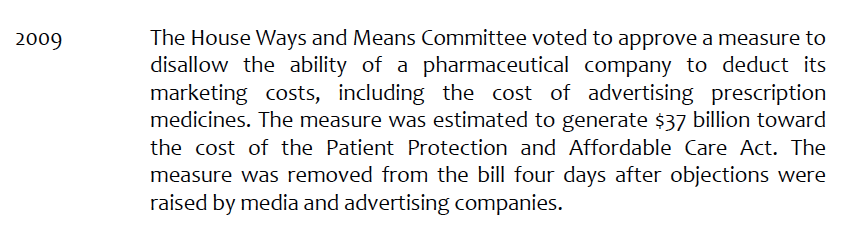
Tax Code section 280E denies tax deductions for advertising marijuana.  That rule tends to promote public health, and to keep the noise down on branding and promotion. Similar rules for alcohol, tobacco, and direct-to-consumer pharmaceutical ads have been suggested, too.

Denying tax deductions for advertising expenses is not a new and fresh idea.  Google “25 Years of Initiatives to Tax Advertising” for a link to the document from the Association of National Advertisers.  Even standard advertising of non-temptation goods tends to have a useful life of over a year (I still remember cola jingles from my youth).  So amortization of all advertising expenses might make sense.

Who gets marijuana licenses?

UPDATED 22 December 2020

Some say let everyone grow cannabis, and Oklahoma is hosting a free-for-all, but some Legislators don’t think marijuana is an ordinary commodity, and think limiting its commerce might protect the public’s health. So they limit licenses.

There are various ways of dealing with excess applicants for marijuana licenses, like holding a lottery, as Washington state did; selling licenses to the high bidder, as colonial India did in the 1800s; or, as the Roosevelt Administration did in 1933, considering each application on its merits and deciding yes or no for each application.  Voucher privatization, where each voter gets a transferrable fraction of the overall quota, may seem far-fetched, but it may be worth a look in Theoryland.

Marijuana licensing “on the merits” leads to disappointed applicants.  At best, merit selection (in the USA) has led to an enormous amount of energy going into appeals and litigation.  At worst, it’s corrupt crony capitalism.

Even lotteries require threshold qualification, whose denial can engender appeals and litigation.  Social equity licensing adds more complexity if not uncertainty.

The Merits in the 1930s

Continue reading “Who gets marijuana licenses?”

RBG and Marty

One good thing about being in the tax policy business in D.C. in the 198os was meeting brilliant people, like Marty Ginsburg, tax professor and lawyer, who came to Capitol Hill from time to time to talk about legislation (though not in my area). I once met his wife, at a party, when she was a circuit court judge.

RBG was extraordinary, but Marty was, too. He was at the top of the tax law heap.

Let’s Ban Marijuana Imports

If the federal government legalizes marijuana, would trade treaties require us to allow imports? Would keeping the feeble Narcotics Conventions in place help?

When initiatives passed, we winked at the treaties and said, “It’s the States that are in violation, not the treaty signatory – not ‘US.’”

Maybe the STATES Act – allowing states to ban imports — would give us that same kind of federalism argument, and show that we’re willing to take our own medicine. The balance was tilted toward globalism for so long. . .

There’s a public health and safety concern, and concerns about laborers and the planet. Banning imports addresses those concerns, too — as well as keeping the wealth here.

Social equity marijuana licenses — fool’s gold?

Social equity licenses have started to seem like fool’s gold to me.

They are a new and fresh idea, with no successful precedent I have found.  (Let me know:  po@newrevenue.org.)

Don’t cite standard preferences or set-asides that unlike social equity licenses can deliver protected and sure benefits.  The Small Business Administration’s 8(a) Business Development Program doesn’t just offer “preference”; it provides a path for small, disadvantaged businesses to receive sole-source and competitive set-aside contracts. The benefit is the contract itself—a protected revenue stream—not just the right to bid against major defense contractors. Good business is guaranteed.  Similarly, an assignment of electromagnetic spectrum delivers a benefit that no one can take away – and that the holder can profit from in all events.  

But a license to sell cannabis – in a general pool where other sellers are well-funded capitalists, often with experience in other states or Canada – may turn out to be worth less than nothing.  I was on a panel for Connecticut state government where a woman spoke of Minority Marijuana Millionaires that social equity licenses would create.  Well, I think John Boehner is doing just fine, and there are plenty of millionaires, but I’m looking for a list of millionaires who were casualties of the War on Drugs. Governments are throwing money at social equity licensees, with training, mentors, loans, etc.  Maybe that will work.  For now, though, the lucky applicants for social equity licenses may be the ones whose applications get rejected.

But a new iteration of social equity licensing is emerging:  ring-fencing opportunities so that only social equity licensees get them.  Massachusetts has started this, with delivery licenses – no competition from wealthy folks (unless they pass themselves off as social equity licensees, or are the real parties in interest – a pattern all too familiar – “Falsely claiming disadvantaged business status, or using sham subcontractors or other structures to circumvent small business, minority/women-owned business, or service-disabled veteran-owned business programs”).

The Massachusetts plan may well cause casualties of the War on Drugs to prosper – though maybe some will lose their shirts.  But ring-fencing seems like a better plan that putting social equity licensees in the general pool with the sharks.

Still, will it work?  In Colombia, “regulations require that cannabis companies purchase 10% of their raw material from small- or medium-sized cultivating communities . . .  However, this approach has not delivered the expected outcome either.” 

Picking winners to profit seems like Crony Capitalism, but nobly, with a heart.  But if it doesn’t produce winners, it’s not good.  And making different people wealthy may not be the goal to seek. 

Another problem: Lots of casualties of the War on Drugs don’t want to be business people. And lots don’t want anything to do with cannabis.

A final killer argument: To spread reparations widely, social equity licensing must rely on trickle-down economics.  The few lucky ganjapreneurs need to spread the wealth back into the wider community.  How is that working out?

Rather than try to create huge profits for a few, government stores or high taxes would fund programs for the general good — or for casualties of the War on Drugs

.  

Making a Carbon Tax Work — BTAs

Marijuana is only the second most interesting field of tax policy today.

BTAs for carbon excise taxes top it.

When we tax carbon emissions, we can tax our industry, but not foreign industry.  BUT we can put on Border Tax Adjustments.  Say a U.S. luxury automobile incurred $15,000 worth of carbon tax.  We can tax its competitor vehicles.  But no one knows how to.  We did tax have BTAs for our chlorofluorocarbon or Ozone Depleting Chemicals tax, very specific ones, in currency per weight by category.

https://newrevenue.org/2017/10/03/border-tax-adjustments-for-carbon-taxes-the-odc-model/

So it can be done.

But for now, no carbon tax.

Tax-targeting big business

Denying deductions for advertising not just for marijuana sellers but for everyone would be anti-big business, pro-Mom & Pop.

$1 out of every $6 spent on restaurant advertising in America [was] done by McDonald’s. https://www.businessinsider.com/this-one-statistic-shows-how-much-mcdonalds-tries-to-entrench-itself-in-everybodys-minds-2012-3. Mom & Pop rely on word of mouth.

And if a jurisdiction wants to tax facebook and google, denying deductions for advertising would pinch them indirectly via the people who pay them.

Baucus actually supported allowing current deductions for only half of advertising, with the rest amortized over the next five years.  Marketing – everything other than cost of goods sold, 280E-style – could fall in that category, maybe.

But there’s the old adage, Don’t pick a fight with someone who buys ink by the barrel.  Or data by the petabyte.

“Stop oligopoly” or “Share the wealth”

Annual marijuana license auctions, mentioned here recently, are a dream in Theoryland, I’m afraid.  (At least they would tilt toward sun-grown – no one would build an indoor grow with a one-year license.)  A more realistic way to time-limit economic power – sunsetted quotas – is on the table in New Zealand now.

Is Canada stopping oligopoly, or sharing the wealth?  Uruguay?  

Revenue options seem a side-show to the real business of allocating licenses.  And worrying about their transferability.  I’m afraid of a cannabis version of Carlos Slim.  (And government monopoly – is PEMEX a success story?)

Annual license auctions are a dream in Theoryland, I’m afraid.  (At least they would tilt toward sun-grown – no one would build an indoor grow with a one-year license.)  

But sunsetted quotas are on the table in New Zealand now.   Licenses next?

MUCD panel today heard me rant against preferential licenses.

Sharing marijuana wealth in Mexico — Panel September 8.

I’m to be on a panel Tuesday, September 8 at 1:30 EDT on cannabis legalization in Mexico – especially preventing oligopoly and market capture by Big Marijuana. It’s open to everyone, in English and Spanish, but you must register first at this link: https://zoom.us/meeting/register/tJYrduCqqzwuE9L3YolRLGPZPtbpIYSDgPi3.

Here are some notes for that panel.

There are possible conflicting goals for tax policy – provide revenue to distribute (maybe to casualties of the Drug War); prevent price collapse to protect public health; nudge in favor of small or deserving businesses.  Administration and feasibility hang over any of those goals.  Taxation is just one design feature, and it interacts with a host of others.  And I know very little about the situation on the ground in Mexico – cannabis culture: the existing market; any role of organized crime.

This is a very hard problem.  Here is a tentative list of options, addressing “avoid hoarding,” and “attaching price to product potency, the nature of the taxes.”  Some of these options may not fit Mexico at all.

+++

OPTIONS

— Retail monopoly

— High taxes

Continue reading “Sharing marijuana wealth in Mexico — Panel September 8.”

Sharing weed wealth — Annual license auctions

A while back, the late Mark Kleiman wrote ““handing out production rights for modest fixed licensing fees . . . [means that] any gain from scarcity pricing will go to the industry and encourage even more vigorous marketing. If, instead, production quotas were put up for auction, the gain could go to the taxpayers. . . . [P]roduction quotas with an auction would be the equivalent of taxes.”

Nineteenth century India, the pioneer in cannabis policy, did just that.  It both imposed taxes and held annual license auctions. “For the retail vend of ganja, charas, and bhang . . . [t]he number of shops is fixed by the Collector according to the demand for the drug. The licenses are sold by public auction for one year.” 

More recently, the State of Louisiana enacted this:  “The Department of Agriculture and Forestry shall develop an annual, nontransferable specialty license for the production of prescribed marijuana for therapeutic use and shall limit the number of such licenses granted in the state.”  That annual cannabis license auction was a backstop or Plan B if state universities elected not to grow cannabis – but they are growing, so there are no annual licenses.

Continue reading “Sharing weed wealth — Annual license auctions”

Issues with the MORE Act

Tax issues with the MORE Act first

I.  280E repeal

 The MORE Act repeals 280E, perhaps the most useful marijuana tax model of all.  (Descheduling marijuana takes if off the bad list cross-reference in 280E.)  280E, denying deductions for selling expenses, makes advertising and marketing more expensive, after tax.  Weed ads, like these “sex sells” billboards, irritate parents.  

The MORE Act devotes revenue dollars to casualties of the War on Drugs, but the tax side is not so friendly.  280E is basically a tax on retailers, and turns out to favor Mom & Pop – or the social equity licensee – over Big Retail Marijuana, like retail chains such as John Boehner’s Acreage Holdings.  

While small businesses may rely on reputation and word of mouth, Big Business advertises.  Recently, “$1 out of every $6 spent on restaurant advertising in America [was] done by McDonald’s.” 

Continue reading “Issues with the MORE Act”