Marijuana mega-millions

Legislatures that legalize marijuana are creating fortunes for friends, so how great the temptation must be to help campaign donors who want to get rich quick by getting licenses to sell marijuana.

Here are case studies from two states where recreational marijuana is not legal.  But medical marijuana alone brings in mega-millions.

Here’s what happened in Florida:

“Less than 24 hours before the Florida Legislature passed the state’s first medical marijuana law in May 2014, Matt Gaetz and other members of the state House of Representatives rewrote the bill to limit who would be able to get in on the ground floor of what has since become a billion-dollar business.

“A number of Gaetz’s friends and allies managed to squeeze through that narrow door. Among them:

“— The brother of Gaetz’s friend and fellow state Rep. Halsey Beshears, who co-founded one of Florida’s first licensed marijuana companies and amassed a fortune currently valued at about $600 million — and became a major Republican Party donor.”

And in Pennsylvania:

“Cultivation and processing operations are fetching $100 million and more. And dispensary licenses are commanding prices of $20 million-$35 million for each storefront as the state’s retail sector consolidates.”

Continue reading “Marijuana mega-millions”

Why the federal government won’t legalize marijuana soon

A friend who advocates for social equity in handling cannabis profits said on a webinar yesterday that federal legalization needs more time – so don’t rush it.  We don’t know how to protect social equity licensees, for one thing.

And Ulrik Boesen of the Tax Foundation has a bunch of questions, like these:

“How does the federal government design an excise tax for this complex market without disrupting state markets? How can federal and state testing and product safety requirements be aligned, considering how much these differ state by state?”

We do indeed need more time.  

To figure out how to reinstitute alcohol taxes after a lapse during Prohibition, Congress devoted four fill days of joint hearings to liquor taxes alone in December 1933.  Unlike with hemp drugs, we had already had lots of experience taxing liquor.  But Congress studied it thoroughly anyway.

Continue reading “Why the federal government won’t legalize marijuana soon”

Pennsylvania Marijuana Monopoly + Taxes = Belt + Suspenders

An article quotes me praising state marijuana retailing over the for-profit alternative — in light of a bill in Pennsylvania to allow just that. The article, at https://www.law360.com/tax-authority/articles/1376043/pa-house-bill-seeks-to-legalize-tax-adult-use-cannabis, is throrough, but paywalled. It gives no prediction for the bill’s prospects.

Continue reading “Pennsylvania Marijuana Monopoly + Taxes = Belt + Suspenders”

280E MJ Tax Technicality, Lawyering, and Risks

A draft sent from me to scholarly private marijuana tax attorney Kat Allen (Tax L.L.M. from NYU) is followed by her response.

My draft:

At a webinar put on by MJbizdaily last week, two contrasting styles of tax lawyering were on display.  Some say section 471(c) lets taxpayers reduce their tax bill under the section 280E Selling Expense Tax; some say it doesn’t.  I don’t know the merits of the 471(c) issue, and hope not to study them.

Continue reading “280E MJ Tax Technicality, Lawyering, and Risks”

Marijuana — Friend or Foe?

Many say marijuana is only good or only evil. (I’m for careful legalization, and sharing the wealth). But this septuagenarian friend, writing in early 2021, has a different take — but not one-sided. There are lots of folks who see both sides, like my old friend:

“I quit, roughly 13 years ago, give or take a few years.  I came to a fork in the road—tennis or reefer.  I could not continue to do both.  The reefer was having too much effect on my stamina and my tennis.  I was getting clobbered by people I used to beat.  So I gave up on the reefer—easily done and done in a fell swoop—and sure enough the tennis got better, until it didn’t, like recently, because of age.  I have never looked back and don’t miss being high.  If ever or when I become decrepit, I will do it again.  It was fun, but not, one hopes, for another decade or so.” 

Continue reading “Marijuana — Friend or Foe?”

280E Is a Bastard. So What?

Critics of the 280E marijuana Selling Expense Tax point out that it was conceived by advocates of the discredited War on Drugs:  “Section 280E was born of politics – at the height of the war on drugs, in 1982.”  Yeah, well, in some way, 280E is illegitimate. But a child born out of wedlock might turn out to be Alexander Hamilton.

The 280E Selling Expense Tax is overbroad, for sure, but it has three big things going for it – from the perspective of much of the marijuana community.

1.  

Advertising and glitzy marketing appeal to kids – and irritate their parents, to the detriment of legalization efforts.  “Marijuana sells itself,” the saying goes.  The commercial free speech doctrine says we can’t ban ads, but sophisticated consumers don’t need the ads or glitz – or the celebrity endorsements.  The 280E Selling Expense Tax makes those kinds of things non-tax-deductible. 

2.  

Big Business advertises and promotes sales more than small business.  Mom & Pop – and social equity licensees – can’t afford the billboards, or deploy the marketing know-how that corporate giants specialize in.  Think Budweiser ads.  And recently, “$1 out of every $6 spent on restaurant advertising in America [was] done by McDonald’s.”  That doesn’t count Burger King, or KFC.   Mom & Pop rely on word of mouth. Big Marijuana wants to start deducting ad expenses — and Big Alcohol and Big Tobacco want to get in on the game.

Small business relies more on free word of mouth than does Big Business. Small business rarely pays for celebrity endorsements, which are nondeductible thanks to 280E.

3.

The 280E Selling Expense Tax barely grazes growers because it allows a deduction for “cost of goods sold” – what the taxpayer pays to produce or buy the product.  So while retailers and distributors can’t deduct wages and rent, growers can deduct wages of workers who grow the product and rent of grow houses and almost everything, because their costs are production costs.  Middlemen and advertisers take a hit from 280E, and so do high-end retail landlords.

+++

The marijuana community, and especially small businesses and growers, might consider not so much the parentage of 280E, but its qualities and defects (yes, it’s overbroad in denying deductions for wages of retail clerks – a selling expense).  But some tax is going to replace 280E — with a more direct hit on consumers if not growers.

Not all bastards deserve condemnation. For a longer though primitive look at 280E, see this Brookings piecehttps://www.brookings.edu/blog/fixgov/2015/12/18/how-bob-dole-got-america-addicted-to-marijuana-taxes/#disqus_thread.

2023 Update: In some ways, the 280E selling expense tax may hit small businesses harder than large ones.  Capital costs tend to be higher for small businesses, for instance, and there will be a certain amount of security costs, no matter how small the business.  Big businesses may get quantity discounts on advertising and other marketing costs. Lots to think about.  This may be updated further.

Here we go: Marijuana is coming to North Carolina

North Carolina medical marijuana just got real.

Medical marijuana legalization is the law in Georgia, and is advancing in South Carolina and Alabama.  Recreational marijuana legalization is the law in Virginia.  Here in North Carolina, nothing was happening.  Only Democrats supported even medical marijuana.

But that changed overnight as two Republican State Senators came out in support of medical marijuana.  So far as I know, they are the first GOP legislators to introduce a medical marijuana bill.

Continue reading “Here we go: Marijuana is coming to North Carolina”

CNR says strengthen the Privileged Heir Tax

The Center for New Revenue is honored to be listed by Americans for Tax Fairness as a supporter of the Sanders-Gomez Estate Tax Reform Bill, the “For The 99.5% Act.”  The wealthy like the term Death Tax; I like Privileged Heir Tax.  Here, I’ll stick to “estate tax” as the bill does.

I got my start in tax work at the Washington, D.C. law firm Covington and Burling in the early 1980s, splitting time between international tax and, under the estimable Doris Blazek-White, estate work.  Back then, the estate tax threshold was much lower, as it should be.  But even then, the rich were getting richer.  Not like now, but privileged heirs and heiresses were already lucking into plenty of wealth they hadn’t earned.

Continue reading “CNR says strengthen the Privileged Heir Tax”

NY legalizes, but keeps marijuna ads non-tax-deductible

We don’t know the best way to tax cannabis, but New York State is advancing the process.

A surprising and useful feature of the New York bill is that it leaves in place “280E conformity.”  The federal government imposes a Selling Expense Tax on cannabis in Internal Revenue Code section 280E, which allows marijuana sellers to deduct only cost of goods sold on federal income tax returns.  

For New York state income tax returns, sellers follow 280E.  So on both federal and state income taxes, they can deduct only outlays to produce or buy the product.  Growers can deduct salaries for ag workers, but no one can deduct outlays for billboards, payments to celebrity endorsers, glitzy showrooms, and much more.  Too much more, maybe – not even minimum wage salaries or health benefits for retail workers.

Continue reading “NY legalizes, but keeps marijuna ads non-tax-deductible”

New York’s Radical THC Potency Tax on Marijuana Flower

We don’t know the best way to tax cannabis, but New York State is advancing the process.

With a THC potency excise tax, New York is starting a bold and radical experiment.  It’s the first jurisdiction in the world to tax cannabis flower or bud – smokeable plant matter – by THC content.  Canada taxes processed cannabis at 1 Canadian cent per milligram of THC, but taxes flower with a weight-based tax, at $1 per gram.  Canada doesn’t tax flower by THC. New York’s tax of 0.7 cent per milligram of THC of flower is revolutionary.  

Continue reading “New York’s Radical THC Potency Tax on Marijuana Flower”

Implications of THC taxation of imported marijuana edibles

Along with some friends, I helped write this for Washington State:

“Concentrates that are infused or contained in other products for retail sale, such as those that go into edibles, sublinguals, tinctures, topicals, suppositories, and other processed cannabis products are additionally difficult to test accurately after being mixed with other ingredients.” Cannabis Potency Tax Feasibility Study: A Report for the Washington State Liquor & Cannabis Board, https://papers.ssrn.com/sol3/papers.cfm?abstract_id=3481584

I remember hearing that from stakeholders out there, and I still believe it, especially for more solid products like edibles.

Say we want, for a domestic tax scheme, a THC tax on concentrates, imposed before mixing or incorporation into a final product.  What do we do about imports?  Take an imported brownie, for instance.

Maybe the Narcotics treaties will prevent imports for a while, but maybe not forever.  Weight-based taxes plainly don’t make sense for brownies or similar imported processed products, which could be loaded with sugar instead of THC or other cannabinoids.  (And we can’t identify the raw plant matter that went into the processed import.)  I’m struggling to think of options beyond THC, sampled after incorporation into the final product, and ad valorem.  Ad valorem is especially unattractive there, with transfer pricing between foreign parent manufacturer and U.S. subsidiary distributor (a typical and unobjectionable business arrangement) a big problem – the foreign manufacturer would like to understate the price of the brownie to keep the ad valorem tax down.

So if we tax the imported brownie on the basis of THC sampled after incorporation into the final product, what about the domestic brownie?  Treat it like the imported brownie, measuring THC late in the process?  Or sample and tax the concentrate that goes into the domestic brownie, early in the process — leading to two similar edibles being sampled and taxed differently?

How Not to Be Wrong — Public Domain Book

Among Bill Gates’ ten favorite books, https://www.nytimes.com/2016/05/20/t-magazine/my-10-favorite-books-bill-gates.html, along with The Great Gatsby and Sapiens and Parenting with Love and Logic, is How Not to Be Wrong: The Power of Mathematical Thinking, by Jordan Ellenberg. Any dense math is skimmable. It’s in the public domain, but the site where I got it said “Not Secure,” so I’m posting it here.

Administrability of Retail THC Tax

Having worked on a study for the State of Washington of the feasibility of taxing cannabis by THC content, I was nervous about the idea.  The report I helped write had this:

“[R]etailers . . .  had little confidence that the POS [Point of Sale] systems could provide the information that they would need to process sales efficiently. Unless potency readings are reliable and readily available at the point of sale, or unless the state uses a simpler model such as a product-based potency estimate to determine a product’s tax, retailers fear that their staff would have to manually calculate tax liability for each item at the point of sale. This would create impossible bottlenecks for stores, many of which move tens of thousands of dollars of product each day. The system of attributing potency to a product would need to be streamlined and automated so as to avoid bud tenders inadvertently collecting the wrong amount, or worse, gaming the system to create a commercial advantage.” https://papers.ssrn.com/sol3/papers.cfm?abstract_id=3481584

But maybe a retail THC tax is more feasible than we gave it credit for.

I wrote Jim Morgan, CFO of the Washington State Liquor and Cannabis Board (WSLCB) and a tax policy and finance expert, whom I had the good fortune to meet in Olympia while working on the study.

From: Pat Oglesby [mailto:po@newrevenue.org] 
Sent: Tuesday, September 29, 2020 3:07 PM
To: Morgan, James E (Jim) (LCB) 
Subject: POS

Dear Jim,

After all this time, do you suppose that POS technology has advanced to the point where a stated THC tax would be about as administrable as an ad valorem tax?

With highest regards,

Pat

He wrote back, with a useful take:

Tue, Sep 29, 2020 at 6:54 PM

Pat,

I am quite sure that POS vendors are skilled enough to build this functionality into their systems.  I believe that THC content is captured in many cases as an attribute of the inventory items in the POS system.  There is not much business value to the cannabis businesses beyond that, though.  Specific functionality that could use this information for tax purposes would only be developed in response to specific regulatory requirements.

Regards,

Jim

++++

I’ve been skeptical of retail ad valorem taxes, so I’m starting to think a retail THC tax is better on policy grounds (for reasons listed in Chapter Five of the RAND Vermont report, https://www.rand.org/pubs/research_reports/RR864.html) — and maybe feasible after all, if a state wants one. It would take some work, but so does every change.

Weed revenue history — British India

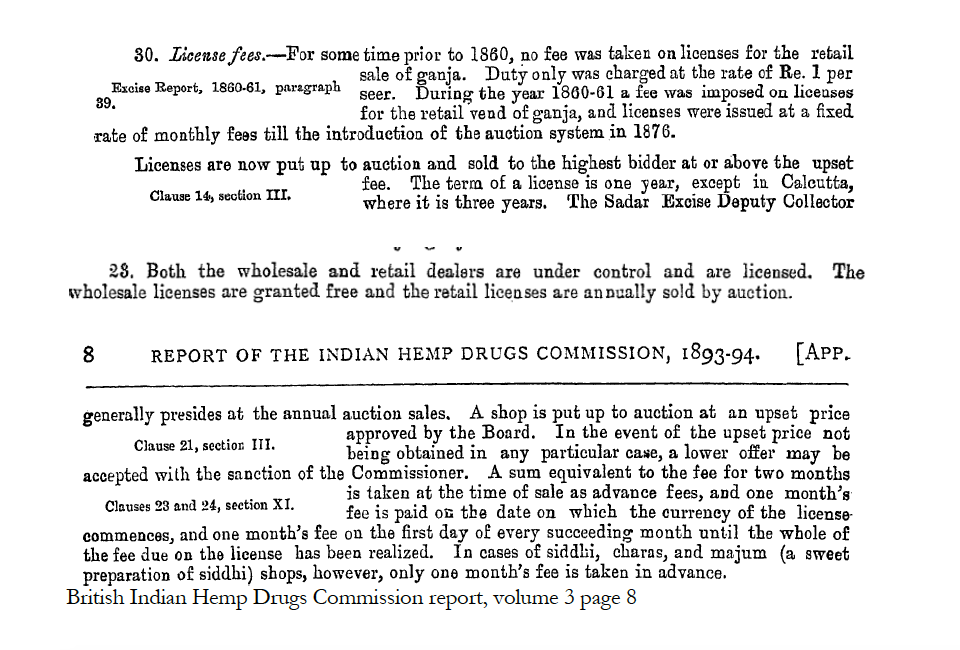
In 1860, British Colonial India created the earliest known marijuana taxes –imposed by weight, at the rate of one Rupee (11.66 grams of .917 silver) per seer (.933105  kilogram) on raw plant material called “ganja.” With silver around $40 an ounce now, 11 grams are worth about $20. So around $8 a pound. (Differential rates for bhang and various types of ganja came later). They were supplemented by fees for retail licenses, sold by auction. Most leases lasted one year; some lasted three.

https://digital.nls.uk/indiapapers/browse/archive/74462705

Black market is out; Bootlegging is in

A draft article I’m working on goes into selling of marijuana illegally, whether in violation of prohibition or of tax laws.  Under legalization, bootleggers, adept at violating prohibition, commit a new and different crime: tax evasion.  But the cat-and-mouse game of enforcement against bootlegging is pretty much the same, whether the crime is violating prohibition or cheating on taxes..  

Several readers object to the term “black market,” on the theory that it has racist origins.  Maybe that’s accurate.  Either way, some say it disparages Black people.  So I’m steering clear of the term.  Words are here to serve people; people aren’t here to serve words.  Cf. Mark 2:27.   (I’ll keep using the derivative term “gray market,” or grey market, referring to transactions like a patient’s selling legally bought medical marijuana to a recreational user.) 

Illegal market, unauthorized market, illicit market – they all take more space and syllables than their predecessor.  What’s the opposite of punchy?  So I struggled for a substitute.  

Bootlegging (origins obscure) is it.  Three syllables.  The permutations — bootlegger, bootlegged — are as short as the old terms or shorter.  And they’re punchy.

Taxing Marijuana Testers

If you don’t think the marijuana revenue pendulum can swing too far, look at a tax singling out the prototype of a business providing clean, lucrative jobs.  Some localities in California tax every ancillary business they can think of – even testing labs.

Someday, people will look back at some of those taxes and wonder, “What were they thinking?  To prove they existed, here are some screen shots showing two localities taxing testing labs specifically.  Lots more California localities tax testing labs under a catch-all cannabis business category.

That testing has to take place somewhere, under California law. What negative externalities doe testing labs create? Those high-tech, highly paid jobs create positive externalities.

Source is “Tax Rates for Cannabis in California Cities and Counties,”  https://cityofshastalake.org/DocumentCenter/View/1460/California-Cannabis-Tax-Rates—July-20-2017-2?bidId=.