Criticism from Vermont

Criticism of my “Sharing the Wealth from Marijuana Legalization” article in www.VTDigger.org prompted this reply, which is waiting for approval at: http://vtdigger.org/2016/02/02/patrick-oglesby-sharing-the-wealth-from-marijuana-legalization/

++++

Thanks for reading. Here are some responses. More to come, maybe.

“Poor writing and fuzzy subject.”

— Ouch! You’re standing on my sore foot.

“Oligarchy,” “disenfranchised,” and “The tax ‘wealth’ will be eaten up by enforcement, studies, testing equipment, training, additional public sector school employees and their related pay and golden benefit packages, prevention measures, counseling, medical bills, unemployment compensation and the growing of the bureaucracy. It will all be good until the full force and effect hits society.”

— Yes, lack of trust in government is a bigger problem than missing out on cannabis revenue, or bad cannabis rules. Why have sensible revenue if the government is just going to waste it? Continue reading “Criticism from Vermont”

Sharing Mj wealth for Vermont

Beyond Democratic Socialism in the form of government ownership, voucher privatization, discussed here, where every voter gets a transferable quota, representing a fraction of the total amount of cannabis to be grown that year, looks a lot like the way Alaska shares oil wealth.

+++

As Vermont considers marijuana reform, here is an article published by VTDigger, a project of The Vermont Journalism Trust, a 501(c)3 nonprofit.

PATRICK OGLESBY: SHARING THE WEALTH FROM MARIJUANA LEGALIZATION

Editor’s note: This commentary is by Pat Oglesby of Chapel Hill, North Carolina, who is the director of the nonprofit Center for New Revenue, a former chief tax counsel of the U.S. Senate Finance Committee, and an independent co-author of the RAND marijuana report for Vermont. The views presented here are only his own.

Passing a law that shares wealth may be controversial. But what if the wealth doesn’t exist unless the law is passed?

Think of the wealth a government creates when it legalizes a drug. There’s legal commerce, and legal wealth, that didn’t exist before. In a pure free marijuana market, all that previously illegal wealth would go to capitalistic businesses. In a pure state monopoly, from seed to store, it would all go to the people – or, at least to their representatives.

Between the extremes, there’s a hybrid: Continue reading “Sharing Mj wealth for Vermont”

Tax rules for campaigns — Soltani

For many of us tax policy people who have seen tax laws made, campaign finance reform is a sore spot, since special interests donate to politicians and get favorable tax rules.

My friend Abdi Soltani, executive director of the American Civil Liberties Union of Northern California, whom I met when we were on the California Blue Ribbon Commission on marijuana legalization, has been thinking about campaign finance reform. He has an article, worth reading in its entirety, containing six ways to use tax rules to address the campaign finance problem.  Here are excerpts: Continue reading “Tax rules for campaigns — Soltani”

3.5% tax yields $8 per person

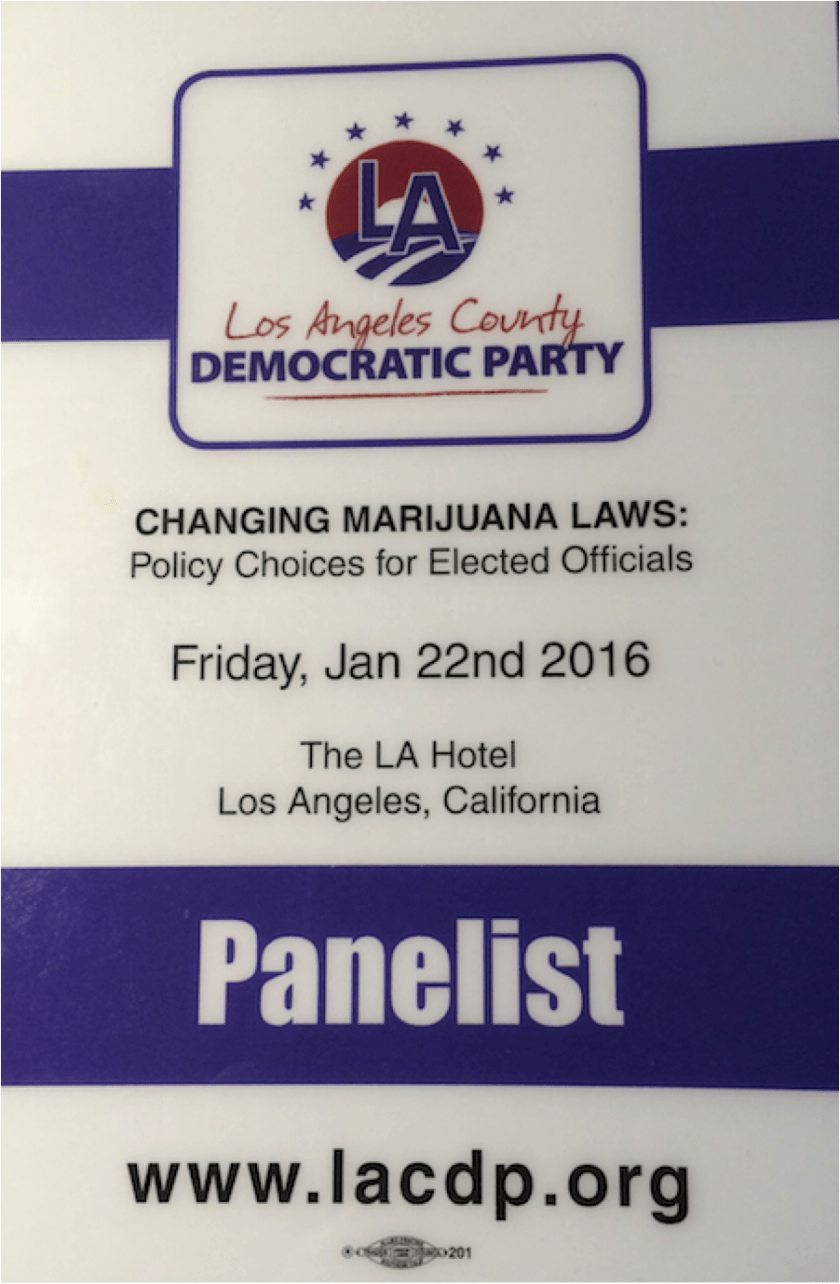
I’m looking at how California localities might tax cannabis – both medical and eventual adult use – in connection with a panel appearance coming up.

How much might they collect?

In 2014, the City of Denver collected about $8 per man, woman, and child from its 3.5 percent tax on recreational marijuana.

Here’s how I get that number. Continue reading “3.5% tax yields $8 per person”

RICO attacks on private marijuana sellers

Thanks to Joel Warner of the International Business Times for quoting me:

While some legal experts questioned whether the [RICO] lawsuit [that settled in Colorado] would have held up in court, the fact that it did so much damage not just to a marijuana enterprise but others who did business with it long before the judge ruled on it means RICO lawsuits could be a grave danger for the industry. Why would anyone want to be affiliated with a marijuana operation if it means they could be sued for organized crime? “RICO is the big deal here,” said Pat Oglesby, a tax attorney who studies marijuana at the Center for New Revenue in North Carolina. “The threat of being sued for that kind of tangential involvement with marijuana commerce could be paralyzing. These are probably not frivolous lawsuits that would allow the defendants to sue the plaintiff for damages for abuse of process.” Here is a more complete statement: Continue reading “RICO attacks on private marijuana sellers”

State marijuana businesses are immune from RICO

My friend University of Denver Law Professor Sam Kamin, who co-chaired the Regulatory and Tax Structure Working Group of the California Blue Ribbon Commission on marijuana legalization with me, is to thank for whatever understanding I have of RICO here. Still, Sam does not necessarily agree with anything I write.

Sam points out that RICO, the Racketeer Influenced and Corrupt Organizations Act, poses a huge threat to private marijuana businesses. A Colorado case just settled out of court, with the defendant marijuana business shutting down, and defendants paying $70,000 to plaintiffs.  Another suit is pending. Continue reading “State marijuana businesses are immune from RICO”

Colorado wholesale marijuana prices aren’t dropping

In Colorado, wholesale marijuana prices are not dropping yet. The latest official data shows bud prices nearly flat over time, but trim prices going up. New official “average market rates” (AMR) – wholesale prices – are here:

AMR Prior to December 31, 2014 AMR as of January 1, 2015 AMR as of July 1, 2015 AMR that will be effective on January 1, 2016
Flower Rate ($/lb) $1876 $2007 $1868 $1948
Trim Rate ($/lb) $296 $364 $370 $464
Immature Plant Rate ($/EA) $9 $9 $8 $9

https://www.colorado.gov/pacific/sites/default/files/AverageMarketRateFactSheet.pdf Continue reading “Colorado wholesale marijuana prices aren’t dropping”

How a forgotten tax footnote limits the marijuana trade — 280E

Newsweek blog picks up Brookings article here, or at http://www.newsweek.com/how-forgotten-tax-footnote-limits-marijuana-trade-408190.  Only the title is different, and they add this caption to a photo of a plant:  “Section 280E of the federal tax code, a 1982 brainchild of Bob Dole’s Senate Finance Committee, is hitting state-legal marijuana sellers in the pocketbook.”

And here it is: Continue reading “How a forgotten tax footnote limits the marijuana trade — 280E”

Dole’s Exemplary 280E

Brookings FixGov blog published what they call a deep dive on 280E on Decmeber 18, 2015.  The Brookings publication is here, but I’ll paste below.  Thanks to John Hudak and Grace Wallack of Brookings for editing it brilliantly, and to Rachel Barry and Emily Oglesby for comments on earlier drafts.  And a hit tip to Bob Dole, a master at legislating.  But maybe 280E was just luck.

+++++

How Bob Dole got America addicted to marijuana taxes

As states legalize marijuana, more marijuana businesses are opening across the country. An obscure 1982 brainchild of Bob Dole’s Senate Finance Committee, section 280E of the federal tax code, is hitting state-legal marijuana sellers in the pocketbook—right now. 280E, which says taxpayers cannot deduct costs of selling federally illegal drugs, is not just helping fund the federal government. It’s also hampering marijuana advertising and marketing—to the satisfaction of nervous parents, and to the consternation of profit-seeking marijuana promoters.

280E was more a political statement than a model of tax policy, and it can’t eliminate marijuana advertising. But it does discourage that advertising, so it may be one of the most useful marijuana tax laws we can imagine. And while some anti-advertising proposals run afoul of the commercial free speech doctrine, 280E is constitutional. So 280E may help slow down Big Marijuana. If so, an anti-advertising tax rule like 280E might come in handy if the public ever musters the strength to take on Big Alcohol and Big Tobacco. Continue reading “Dole’s Exemplary 280E”

Responsible Ohio 2015 Marijuana Text

Here is the text of the failed 2015 Ohio marijuana legalization initiative.  My source, http://responsibleohio.com/the-amendment/ no longer links to anything. (http://responsibleohio.com/ now converts to http://freemarketohio.com.)  Skip the long-winded summary by searching for “FULL TEXT OF AMENDMENT.”

Amendment

TITLE

Marijuana Legalization Amendment

SUMMARY

This Amendment would add a new section 12 to Article XV of the Ohio Constitution Continue reading “Responsible Ohio 2015 Marijuana Text”

Dropping Walgreen’s thanks to tax audit

As a result of a recently completed federal income tax audit, I stopped getting prescriptions from Walgreen’s. All my other health care providers, physicians and pharmacies, when asked, sent me a full list of everything I spent on deductible purchases in 2013. Walgreen’s made me ask in writing twice, and then sent me an incomplete list as if it were complete. They never furnished a full list (leaving me to rely on receipts that included items their list omitted). Continue reading “Dropping Walgreen’s thanks to tax audit”

Senator Dole and 280E

For folks from North Carolina, who think of Elizabeth Dole, who passed through here long enough to get elected as our Senator, as Senator Dole, I think of her husband as the real Senator Dole.

Bob Dole, when Chair of the Senate Finance Committee, was a great American, I thought. He was looking to protect his friends, but he didn’t mind taxing other people. That was the best the public could get back then, and may still be. The alternative is Don’t Tax Anybody, which calls for selling a lot of assets.  Or going broke.

Newt Gingrich once called him the tax collector for the welfare state.  Senator Bob Dole didn’t have the visceral anti-tax attitude that seems prevalent in today’s GOP.  It’s not surprising that in 1982, when the idea of 280E, denying deductions for selling illegal drugs, came up, it came up in Bob Dole’s Finance Committee.

Marijuana revenue requires patience

Revenue from marijuana will be small at first, because highly taxed legal commerce can’t beat the black market. RAND’s 2015 Insights for Vermont makes that point clearly. Liquor taxes had to stay low for a while after Prohibition was repealed, as 2011’s “Laws to Tax” pointed out.

Elected officials in Colorado are having to explain that to the public. Here’s an excerpt from an article by Peter Marcus in the Durango Herald, titled “Hickenlooper: Marijuana not a budget savior”:

Gov. John Hickenlooper on Thursday said now is not the time to consider marijuana tax revenue as a new funding source for Colorado. . . . Continue reading “Marijuana revenue requires patience”

Gvt stores favored

Canadians, like North Carolinians, say they prefer the safer alternative for marijuana commerce – government control of retailing. The RAND Report for Vermont explains why government stores are safer, and more cautious. This HuffPo article explains why government stores are not impossible in the United States.

Here are the results of the recent poll in Canada, where several provinces  allow liquor sales only through government outlets.  :

“When asked how legal marijuana should be produced and sold, the largest group opts for a distribution system where large corporate growers only are licensed to grow marijuana and it is sold through government agencies like liquor boards (45%), Continue reading “Gvt stores favored”