Does a milligram of THC in flower have the same effect as a milligram in an edible?
Yes, supposes the London, England, Mayor’s report. No, say Connecticut and the Marijuana Policy Group.
Continue reading “How does THC correlate with intoxication?”Does a milligram of THC in flower have the same effect as a milligram in an edible?
Yes, supposes the London, England, Mayor’s report. No, say Connecticut and the Marijuana Policy Group.
Continue reading “How does THC correlate with intoxication?”After this post, the NC House stripped out the CBD ban and ended up with only age-gating at 21. The bill moves on to the Senate as of June 26, 2025.
Here’s the original post, for the record:
++++++
The primary intoxicant in marijuana or cannabis is THC. CBD, meanwhile. is universally acknowledged to be non-intoxicating .
But the North Carolina Farm Bill Drug bill that passed the Senate and is heading for the House allows THC but bans CBD. That’s crazy!
A Legislator told me I’m missing something — so I may be wrong here. But I offered a reward on Twitter or X for an explanation of what I’m missing, with no takers.
Let’s take a CBD gummy with no THC of any kind. I think it’s a “prohibited hemp-derived consumable product” under North Carolina House Bill 328.
Continue reading “How the NC hemp bill, HB328, bans CBD — This got fixed”
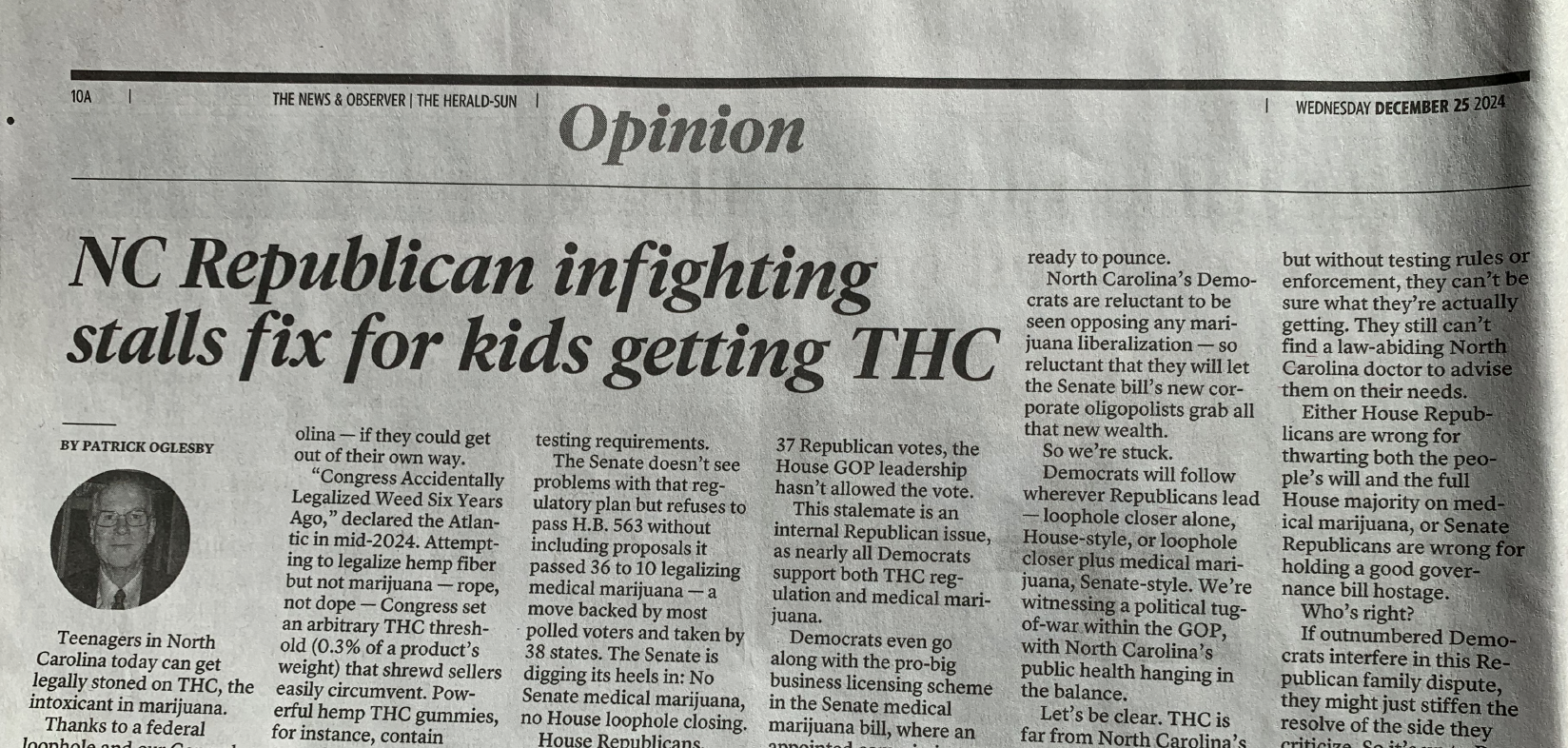
Here’s the op-ed I wrote, posted December 24, 2024 9:36 AM at https://www.newsobserver.com/opinion/article297404669.html;https://www.charlotteobserver.com/opinion/article297404669.html?tbref=hp;https://www.heraldsun.com/opinion/article297404669.html;
printed in the Raleigh News and Observer, Charlotte Observer, and Durham Herald Sun Christmas day editions.)
+++
UPDATED 22 December 2020
Some say let everyone grow cannabis, and Oklahoma is hosting a free-for-all, but some Legislators don’t think marijuana is an ordinary commodity, and think limiting its commerce might protect the public’s health. So they limit licenses.
There are various ways of dealing with excess applicants for marijuana licenses, like holding a lottery, as Washington state did; selling licenses to the high bidder, as colonial India did in the 1800s; or, as the Roosevelt Administration did in 1933, considering each application on its merits and deciding yes or no for each application. Voucher privatization, where each voter gets a transferrable fraction of the overall quota, may seem far-fetched, but it may be worth a look in Theoryland.
Marijuana licensing “on the merits” leads to disappointed applicants. At best, merit selection (in the USA) has led to an enormous amount of energy going into appeals and litigation. At worst, it’s corrupt crony capitalism.
Even lotteries require threshold qualification, whose denial can engender appeals and litigation. Social equity licensing adds more complexity if not uncertainty.
The Merits in the 1930s
Continue reading “Who gets marijuana licenses?”