Draft to the authors of “The impact of taxes on prices and the demand for legally sold recreational Cannabis in the U.S.—An economic evaluation” (link below)
Dear Authors,
Thanks for your paper in Sciencedirect on cannabis taxes, a focus of the Center for New Revenue.
I’m missing something here:
“A $1 increase in cannabis taxes leads to a $4–$6 increase in cannabis prices.”
How can that be?
I
Most U.S. state taxes are simple add-on ad valorem at retail – where a $1 increase in taxes will increase prices less than $1, as the seller will bear some of the burden.
How much less? Hansen et al say “we find that consumers bear about 44 percent of the retail tax burden.” https://www.nber.org/system/files/working_papers/w23632/revisions/w23632.rev0.pdf
II
A handful of states, like Canada, tax upstream of retail.
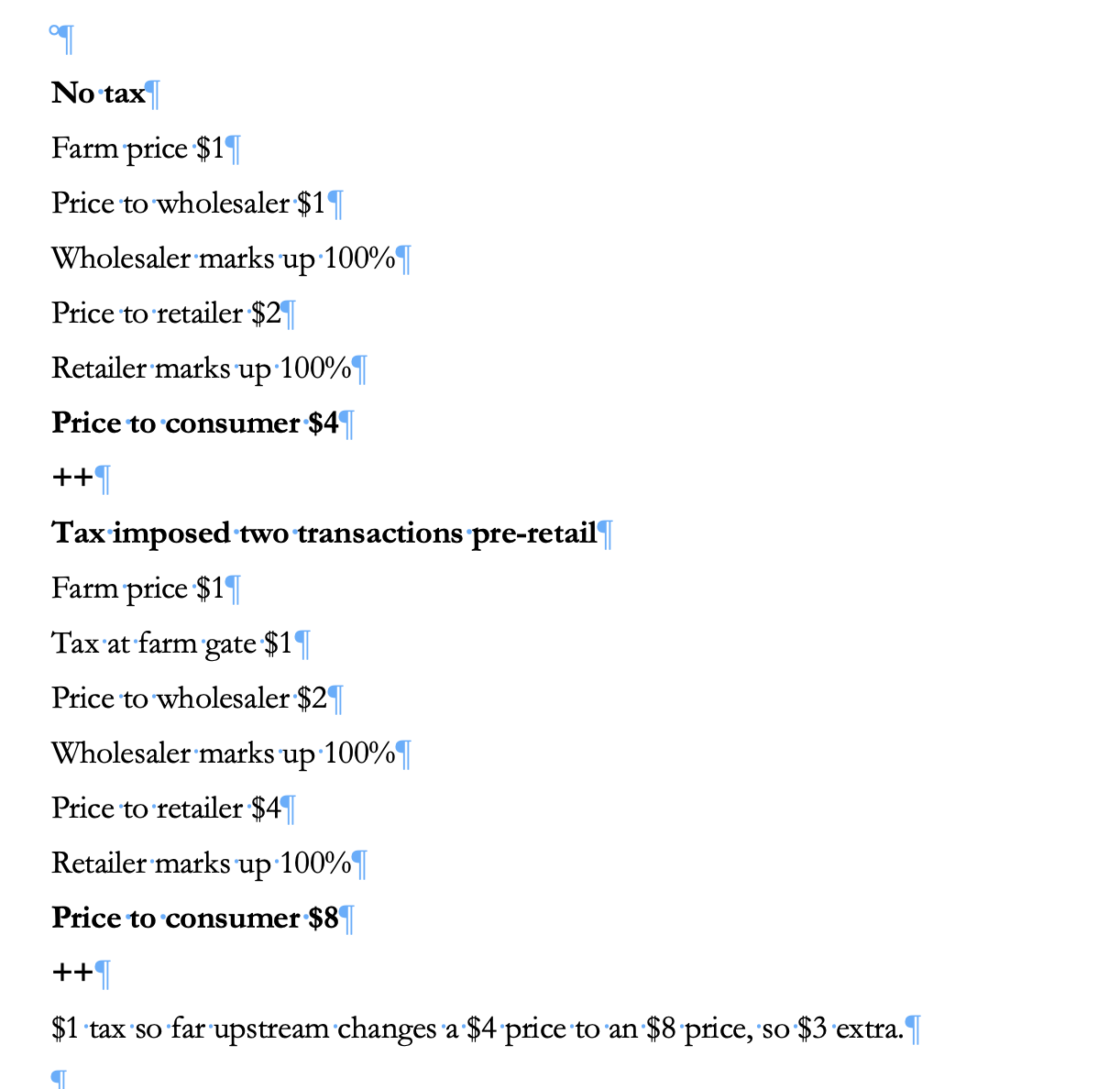
Now I can make up a case where a $1 tax far upstream adds an extra $3 to the consumer’s price, but I know of no real cases even approximating the facts in that made-up case. Compound levels beyond three and you can get to $4, but only in Theoryland.
III
Justin Leiby, a professor friend in Illinois, tweets,” Not believable. At 1st glance, it looks like there’s a mechanical relation. The tax variable for ad valorem states = statutory rate × retail price. If a state has a 15% tax, it equals 0.15P. Then, they regress P on that tax variable, so they regress P on 0.15P plus noise.”
I don’t understand the regression part.
++++
I’m learning something all the time.

