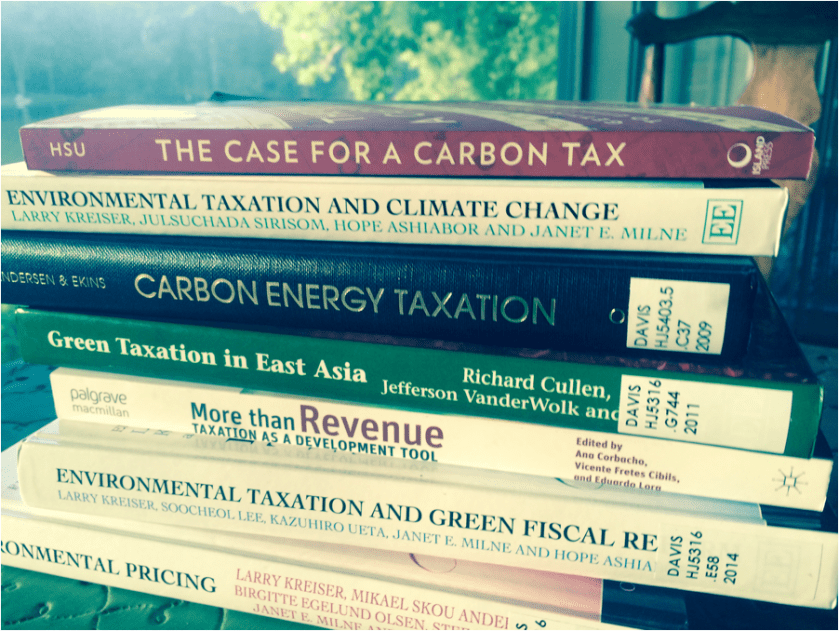
Use government cash or tax cuts to subsidize clean energy? No wonder we’re going broke.
With Exxon supporting a carbon tax, the topic is getting serious. Lots has been written already; here’s a sample from UNC Library.
“Louisiana State University and [HBCU] Southern University want to begin growing marijuana for medical use. The boards of both schools approved plans Friday to pursue licensing, making them the sole growers and researchers for the state, The Associated Press reported.” The source is here.
LSU’s vice president for Agriculture “said university officials believe they can meet security requirements and retain federal funding. He said LSU could become a leader in research on the medicinal properties and cultivation of marijuana.”
Objections to states getting in the marijuana business are looking weaker. Continue reading “State Universities to grow marijuana”
Humboldt County, California, Board of Supervisors unanimously approved a cannabis cultivation canopy excise tax Tuesday. “Outdoor, mixed light, and indoor farms would all be taxed differently. An example is smaller outdoor grows would be taxed $1 per square foot while the large outdoor grows would be taxed $6 per square foot.” So small growers get a tax break.
The details have not been drafted. The press report, from KRCR, does not say whether outdoor grows would be taxed more than indoor.
In particular, one thing to watch for is whether the tax contains absurd marginal rates, or cliffs, at break points between categories. Continue reading “Canopy tax in Humboldt”
Concentration of economic power makes me nervous, and I’m unpersuaded by the assertion that “”Top researchers just demolished a huge fear about legal pot” in a Brookings study saying, “Worry about bad marijuana—not Big Marijuana.” Big companies selling marijuana will have economies of scale to push prices way down, and political power to oppose tax increases.
Now well organized small businesses, acting in concert, can have plenty of political power, adequate to prevent taxes from going up. Here are a couple of anecdotes, based on my recollections from working for Congress three decades ago, before Citizens United:
The major, multinational oil companies were pretty good at lobbying, but the small, independent producers Continue reading “Big = Powerful?”
Having the strong view that alcohol taxes are kept too low in the United States by a combination of industry power and anti-tax sentiment, I was startled to see this ambivalence (at best) from my friend John Hudak and his colleague Jonathan Rauch at Brookings:
“Public health advocates would like to see less advertising reaching minors, and they argue that alcohol taxes are too low to cover social externalities and deter use. The industry argues that taxes are already punitively high.15 Because regulatory practices and taxes differ across states and change over time, generalizing is complicated. On the whole, however, the regulatory regime for alcohol does a credible job of restraining antisocial and irresponsible practices, has proved to be broadly acceptable to the public and the industry, and has also proved to be stable and sustainable. In those important respects, modern regulation of Big Alcohol is a success story.” Continue reading “Alcohol taxes — Brookings”
Transfer pricing at Duke for private sector and government people, with Professor Peter Barnes. Half the class in this one-week international tax program was female. I was delighted to sit in and to speak a little. I don’t remember much from 20+ years ago, but transfer pricing still leaves a lot of money in tax havens — stateless income.
Program site: http://dcid.sanford.duke.edu/academics/exed/transfer-pricing
This week, a Transfer Pricing Exec Ed Program at Duke is being taught by my old friend from government service, Peter Barnes. I’ve been sitting in some, and am to speak tomorrow (against the separate entity and for formulas, as much as possible).
International is the hardest part of tax.
Transfer pricing is the hardest part of international.
Intangibles are the hardest part of transfer pricing.
A lot is new. For the first time in years, I’ve heard people talk about a “real country” – one that’s not a tax haven, or phony country.
Appearing on the Russ Belville show today, 6:30 EDT, 3:30 PDT. http://RadicalRuss.com, to talk about revenue from cannabis.
Audio of an earlier interview is here: https://www.youtube.com/watch?v=-w-icz6v8Wc
We in North Carolina vote for Supreme Court June 7 (early voting has started). I have two friends, Sabra Faires, an Independent, and Bob Edmunds, a Republican, on the ballot. Meanwhile, the state Democratic apparatus is behind a third candidate,
I’m a Democrat, but this election is officially nonpartisan. I’m for Sabra, not just because, like me, she’s a tax lawyer and former legislative staffer. I’d add some of the reasons listed by the Charlotte Observer and the AFL-CIO. The Republicans in the Legislature tried to make this a retention election — an up or down vote on my friend Bob. Sabra challenged this unconstitutional shenanigan in court, and won. More power to her.
A report from the ACLU of New Jersey calls for phasing in marijuana tax rates, stepping rates up from 5 percent in the first year to 25 percent eventually. It follows phase-in proposals by Congressman Earl Blumenauer and others, and a law on the books in Pueblo, Colorado, described here.
This phase-in makes sense. The legal market can bear more tax as time goes on. Startup costs and uncertainties put the nascent legal market at a disadvantage that will fade over time, especially as enforcement of the new legal set-up takes effect.
The Tax Foundation finds fault with many excise taxes (tobacco, e-cigarettes, sugar, airline services, medical devices, you name it – though, to be fair, the Foundation puts gasoline taxes on the table). So it’s no surprise that it proposes very low federal excise taxes on marijuana. Its federal marijuana tax would be a nickel a gram — compared to the $1.76 per gram tax on the books in Alaska. That is supposed to bring in just $500 million a year nationwide. That looks like chump change.
The Foundation doesn’t mention what happens to the anti-marijuana-advertising rule of Tax Code section 280E, which is bringing in lots of revenue, according to the complaints of retailers. Any modification of 280E would offset other revenue gains. It could wipe out all the revenue from the chump change excise tax.
OK, the Foundation puts forth an alternative federal tax that would raise more — but doesn’t include that higher tax in reaching a $28 billion revenue estimate for marijuana taxes annually, at first. Here are excerpts from the Foundation’s recent report, Continue reading “Chump change from Tax Foundation”
NYU panel on marijuana tax: For a video, click here or go to https://www.youtube.com/watch?v=o5Ob81JIRVk&feature=youtu.be&. Beau Kilmer moderates; I start off, followed by Miles Light, Steve Davenport, and Congressman Earl Blumenauer. The Congressman still clings to total repeal of the 280E tax, despite some surprise at that stand from an audience member.
Here’s an timeline of my comments, on the tax base:
Tax #cannabis by
3’10″ Price
6’35″ Weight
7’30″ THC
9’35″ 280E no deductions for ads Continue reading “NYU tax panel”
Having looked at deliberately low Post-Prohibition federal alcohol taxes as a model for low early cannabis taxes (with the RAND Vermont report alluding to a “tax holiday”), I was glad to see some state history pointing in the same direction. The following is from “The Failed Promise of Legal Pot,” By Tom James, in the Atlantic:
“Rear Admiral Luther E. Gregory . . . held the solution to a much earlier black market in Washington state. Continue reading “Ultra-low marijuana taxes — but only at first”
Updating a post from 2013, which reported that 280E was “Not Strictly Enforced.” First, the old post; then, some current reactions. Continue reading “280E Enforcement”
Notes for talks to local California elected officials and staff about local taxes on cannabis, to be given in Riverside April 21 and Irvine April 22. Continue reading “Local cannabis taxes in California”
Here’s news about local marijuana revenue in Southern California, from the Press Enterprise, http://www.pe.com/articles/marijuana-800455-city-desert.html?page=2. All that follows is an excerpt:
Desert Hot Springs is preparing to become what one grower called “the Silicon Valley of marijuana” by granting permits to cultivate. At least one project is expected to start construction in about a month. Continue reading “Desert Hot Springs looks at huge revenue from cannabis”
This is included in a April 21 post on newrevenue.org.
I’m giving panel talks on this topic April 21 and 22 in Riverside and Irvine, California. California gives localities a free hand, legally, to impose taxes and fees on cannabis commerce, but economically, their hand is less free.
7 reasons localities have limited economic power to collect taxes or fees on cannabis: Continue reading “Limited local economic power to tax cannabis”