Taxing “popcorn bud” by weight in Nevada

States have proliferating categories of cannabis products to tax by weight – categories designed to be proxies for potency.  Here’s an explanation I got about one in Nevada from Jorge Pupo, Deputy Executive Director, Marijuana Enforcement Division, Nevada Department of Taxation, who authorized me to share it in a talk I give in Los Angeles next week at the http://northamericancannabissummit.org.

“Small bud or popcorn bud tends to be lower in THC and mainly used for making pre-rolled joints or mixed with the trim for extraction.

“It is pretty well established in industry what “popcorn bud” is. It tends to be a lot smaller than the average flower and found low in the lower part of the plant. It is smaller because it is harder for light to reach the lower end of the plant, even when fan leaves have been removed [a problem for sampling for THC, but that’s not my point — PO].  The Department marijuana auditors and inspectors check the trim inventory and small buds or popcorn during the routine inspections.”

How workable that is, I don’t know.  Colorado has six different categories.  But this approach aims at potency more directly than an ad valorem tax does.


MPP Rhode Island Report

I can’t find the 2018 Marijuana Policy Project report for Rhode Island on the web, so here it is:  2018 mpp report regulation-report.

Here is an excerpt:

price-based taxes suffer from two problems. First, the price of legal marijuana will likely continue to fall as the market becomes more efficient and production costs decline. Revenue from a price-based tax will thus fluctuate with price, meaning that it will likely decline over time. If states are looking to marijuana taxes for a consistent revenue stream to fund other programs, taxing the price of marijuana is not necessarily a dependable way to do that. The second problem Oglesby identifies is “phony pricing,” such as product bundling. Product bundling could, for example, involve a retailer selling a marijuana pipe for much more than it’s worth and including marijuana as a free “gift” alongside, effectively avoiding the marijuana tax. He warns that states with price-based taxes should be sure to include language in their legalization law that prohibits this kind of tax evasion. Price-based taxes are also vulnerable to other tactics (some of them legitimate) such as employee discounts and quantity discounts. Continue reading “MPP Rhode Island Report”

Taxing by price ≠ Taxing by potency

A criticism of taxing marijuana by weight is that it should incentivize more potent product, while a price-based tax should not.  Critics have suggested that customers will pay much more for an ounce of potent product – which would bear the same tax as a weak ounce.  Taxing by price, they say, will avoid that incentive.

But new data shows that  potency and price are not tightly related.

Dr. Caroline Weber of the University of Washington sent me this chart:  https://newrevenue.org/wp-content/uploads/2018/11/table_for_pat_oglesby.pdf.  It comes from her and from two University of Oregon economists, Ben Hansen and Keaton Miller, and considers about 60 million retail transactions.

If price followed potency directly, if a gram of 10-percent THC cannabis sells for $7, a gram of 15-percent THC cannabis would sell for $10.50 = $7 (15/10).

But in fact, in those 60 million transactions, a shift between 10 and 15 percent potency typically increases the price of a gram by much less than the 50 percent increase in potency.

In Table 1, the regression coefficient of THC concentration for the tax-inclusive price of cannabis in Washington State is 0.188, if I have the terminology right.

Using Table 1: If a gram of 10-percent THC cannabis sells for $7, a gram of 15-percent THC cannabis would sell for $7.94 = $7 + ((15 – 10) 0.188).

Meanwhile, using Table 2: If THC increases by one percentage point, price increases by 2.05 percent. So if a gram of 10-percent THC cannabis sells for $7, a gram of 15-percent THC cannabis would sell for $7.75 = $7 X (1.0205 to the 5th power)).

Now the sophisticated weight-based schemes in place in Alaska, California, Colorado, Maine, and Nevada, all tax multiple categories of product to tax.  Potent bud is typically taxed at about three times the rate per ounce used for less potent bud.  These weight based taxes may reflect potency better than price-based taxes.

In any event, price is not a very good proxy for potency.


Official 280E revenue cost — $5 billion over 10 years

Click on 370531229-Senator-Gardner-280E-Score-12-04-2017 for a letter from Joint Tax Deputy Chief of Staff Robert P. Harvey to Senator Cory Gardner (R-CO) indicating that repeal of the section 280E limitation on tax deductions for state-legal marijuana sellers would cost $5 billion over 10 years.  That letter, dated December 1, went out before Massachusetts voted to legalize.  The estimate could go up over time.

I do a speculative analysis, independent of the Joint Tax analysis, at https://newrevenue.org/2017/02/02/5119/.

Price doesn’t follow THC content closely

Dr. Caroline Weber of the University of Washington sent me this chart:  table_for_pat_oglesby.  It comes from her and from two University of Oregon economists, Ben Hansen and Keaton Miller, and considers about 60 million retail transactions.

The regression coefficient of THC concentration for the tax-inclusive price of cannabis in Washington State is 0.188, if I have the terminology right.

A shift between 10 and 20 percent potency would only increase the price of a gram by much less than a doubling.

Maine’s weight-based marijuana taxes

Here are Maine’s marijuana producer tax rates, in addition to its 10 percent retail tax.  The Legislature overrode the price-based producer taxes that the voter initiative contained:

  • $335 per pound of marijuana flower or mature marijuana plants;
  • $94 per pound of marijuana trim;
  • $1.50 per immature marijuana plant or seedling; and
  • $0.30 per marijuana seed.

http://news.cchgroup.com/2018/05/07/maine-enacts-marijuana-taxes/


Weak correlation between THC concentration and cannabis price

I’m posting a table covering cannabis sales in Washington that was prepared by Ben Hansen, Keaton Miller, and Caroline Weber – academic economists out west, the first two authors at the University of Oregon, the last at the University of Washington.  They authorized me to share it.  Click here:  table_for_pat_oglesby

The table shows only a small correlation, 0.188, between (reported or claimed) THC concentration and price per gram, so it seems to chip away at the claim that a price tax base is a pretty good proxy for a THC tax.

The research considers about 60 million retail transactions.

If price followed potency directly, if a gram of 10-percent THC cannabis sells for $7, a gram of 15-percent THC cannabis would sell for $10.50 = $7 (15/10).

But in fact, in those 60 million transactions, a shift between 10 and 15 percent potency typically increases the price of a gram by much less than the 50 percent increase in potency.

In Table 1, the regression coefficient of THC concentration for the tax-inclusive price of cannabis in Washington State is 0.188, if I have the terminology right.

Using Table 1: If a gram of 10-percent THC cannabis sells for $7, a gram of 15-percent THC cannabis would sell for $7.94 = $7 + ((15 – 10) 0.188).

Meanwhile, using Table 2: If THC increases by one percentage point, price increases by 2.05 percent. So if a gram of 10-percent THC cannabis sells for $7, a gram of 15-percent THC cannabis would sell for $7.75 = $7 X (1.0205 to the 5th power).

So upon a 50-percent increase in potency, instead of a 50-percent increase in price from $7 to $10.50, the expected price is less than $8.  The price increase is less than 14 percent.

Now the sophisticated weight-based schemes in place in Alaska, California, Colorado, Maine, and Nevada, all tax multiple categories of product.  Potent bud is typically taxed at about three times the rate per ounce used for less potent bud.  California’s tax for flower is $9.25 per ounce; for leaves or trim, it’s $2.75.

In any event, price is not a very good proxy for potency.  Those weight-based taxes may well correlate with potency better than price-based taxes do.


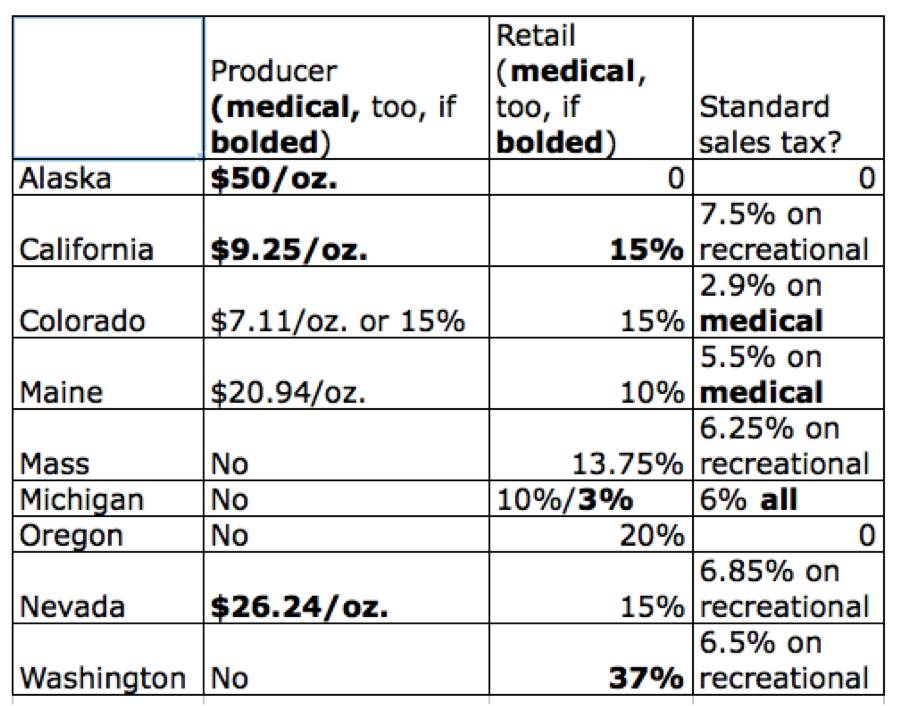
Current state marijuana taxes

 Current mj taxes with MI 3 columns big font 
Note the bolding for medical.

This chart reflects legalization in Michigan on Election Day 2018.   Recreational is taxed at 10 percent at retail;  there was no change in taxation of medical, taxed at 3 percent if sold at a dispensary, but exempt if sold by a caregiver.  All cannabis, recreational and medical, is subject to the state’s standard 6 percent sales tax.

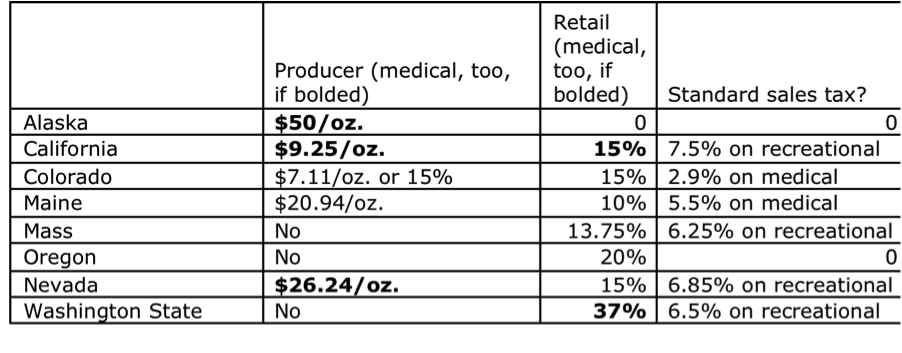
State Flower Taxes Today

Note the bolding, above.  Nevada taxes all cannabis de facto by weight; Colorado taxes producers by weight unless there is an arm’s-length sale.

Oregon’s 20-percent number reflects a 17-percent state tax and universally adopted 3-percent local taxes.  Otherwise local taxes are more of a patchwork, and are ignored.  Colorado and Nevada have nominal 15-percent producer taxes.  Colorado converts its tax to a weight base for related party or vertically integrated cases. https://newrevenue.org/2017/07/23/is-colorados-new-marijuana-tax-leaky/. Nevada converts to a weight base for all cases. https://newrevenue.org/2017/07/02/nevadas-70-cent-per-gram-tax-on-marijuana-flower/

Details on Washington:  Exemption from 6.5% standard sales tax for medical marijuana: https://dor.wa.gov/find-taxes-rates/taxes-due-marijuana.  Obligation to pay 37 percent excise tax on medicalamarijuana: https://dor.wa.gov/sites/default/files/legacy/Docs/Pubs/SpecialNotices/2016/sn_16_med_endorsement.pdf.

S.2478 – End Taxpayer Subsidies for Drug Ads Act

Senators McCaskill and Shaheen have a bill to stop tax deduction for prescription drug ads. The American Medial Association and my drug policy friends approve.  This stoppage would treat Rx drug ads like marijuana ads — and nudge against them via taking away this tax break.  Maybe freedom of speech (for marijuana, in state Constitutions) won’t let us stop the ads, but we don’t have to subsidize them.

Proposed section 280I text includes:

No deduction shall be allowed under this chapter for expenses relating to direct-to-consumer advertising of prescription  drugs for any taxable year. 

Why not do the same for alcohol, tobacco, and opioids?

CNR comments to Vermont Marijuana Commission

Dear Members of the Vermont Marijuana Commission:

It was a privilege to serve as co-author of the RAND Report, Considering Marijuana Legalization: Insights for Vermont and Other Jurisdictions, http://www.rand.org/pubs/research_reports/RR864.html, and as the only attorney and tax person to do so.

I would be delighted to try to come to speak with you if you would be willing to hear me. In any event, here are the four main points I would make.

1.  Taxes can and need to go up over time. Already, economists say, “[D]espite having the nation’s highest tax rate, Washington . . . could generate significantly higher revenue by increasing the tax rate.” Continue reading “CNR comments to Vermont Marijuana Commission”

California 280E tax needs fixing

I was surprised and heartened to that California Governor Brown vetoed AB 1863, keeping non-deductibility of marijuana advertising expenses on California individual income tax returns. His rationale is revenue loss and the bill’s evasion of the budget process. https://www.gov.ca.gov/wp-content/uploads/2018/09/AB-1863-Veto-Message.pdf

And I was surprised and heartened to see that the California Legislature hasn’t overridden a veto since 1979.

So there is an opportunity for California to tinker with 280E conformity to treat individuals and corporations the same and not lose revenue. Continue reading “California 280E tax needs fixing”

British Indian Hemp Commission vol. 3: Title page to page 17

For instance,

“Another point to which the attention of the Commissioners should be directed is the probability or possibility, that if the use of hemp-drugs is prohibited, those who would other-wise continue to use them may be driven to have recourse to alcohol, or to other stimulants or narcotics which may be more deleterious.” 

IHD vol 3 pages Title-17 or so74464868_53_72


CNR urges veto of California AB 1863

Here is a message I sent Governor Brown of California about a bill to allow individual sellers of marijuana, like corporate sellers, to deduct advertising and marketing expenses on their state income tax returns:

+++

AB 1863 loses revenue.

California should treat individuals and corporations alike for marijuana tax deductions:  Let everything be deductible but advertising and marketing.

That might raise revenue (or maybe come out neutral to avoid 2/3).  It would be better for the budget. Continue reading “CNR urges veto of California AB 1863”