Best Marijuana Taxes Yet: California’s Proposition 64

Best Marijuana Taxes Yet: California’s Proposition 64

Two devastating traps threaten taxes on newly legalized marijuana. One is the quicksand of inflexibility, leading to impotence during a whirlwind of market change. The other is playing favorites, opening an abyss of tax evasion. California’s Proposition 64, on the ballot in November, avoids those traps better than any marijuana initiative voters have ever seen.

The test of time

Taxing the embryonic legal marijuana industry is like buying clothes for an expected baby. Prepare for changes. The marijuana industry will evolve in ways we can’t predict. We don’t know the best way to tax marijuana, and even if we knew, that way will prove wrong as the market evolves, with free market entrepreneurs pursuing wild ideas, surprising everyone but themselves.

But we can foresee one trend. The early legal market will face a price war from the incumbent black market, but then pre-tax prices will drop, as the legal market is liberated from the “prohibition premium” — the extra costs and risks of operating illegally. That is, eventually, the legal industry will grow and become efficient, pushing pre-tax prices down – way down. Why should cannabis cost so much more than tea? Pre-tax, after federal legalization, it won’t.

Taxes calculated as a percentage of price are child’s play to create. A price-based tax will start strong. Then, as pre-tax prices collapse, so will price-based tax collections. Continue reading “Best Marijuana Taxes Yet: California’s Proposition 64”

Staging Marijuana Taxes

Here’s how to start low and go slow: Not just phase-ins of rates, but staged effective dates for each new excise tax or tax base, one by one—that’s the insight from the Hoover Institution’s Alvin Rabushka’s enormous Taxation in Colonial America, now discounted to under $30 in paperback.

RAND-Vermont put it this way:

“The simplest, least evadable revenue sources come first. Flat annual license fees are easy to collect: Authorities have to find the enterprise just once and do not have to measure anything. Import duties are easier to collect than excises: Continue reading “Staging Marijuana Taxes”

Does California Law Limit Localities’ Legalization Options?

Do municipalities in Washington State and Maryland have more freedom to experiment with marijuana legalization than those in California?

Here’s the context:

A cautious way of legalizing marijuana is to have government stores do the selling. That may sound like socialism, or Democratic Socialism. But it’s the plan that teetotaling Baptist businessman John D. Rockefeller, Jr., urged for alcohol at the end of Prohibition. He put habit-forming intoxication in a separate category of commerce, separate from commerce where the free market works best.  Government stores not only allow more control of commerce, they can allow the government a revenue advantage.

And since March 2015, for marijuana, North Bonneville, Washington, has been using just that method.

Now Oakland, California, home of America’s first marijuana tax, approved by voters by a 4-to-1 majority in 2009, is considering municipal ownership of all new marijuana businesses. Continue reading “Does California Law Limit Localities’ Legalization Options?”

Phasing in marijuana taxes — Monterey County

It sounds like taxing jurisdictions are waking up to the shrewdness of keep marijuana taxes low at first, but not forever, as the industry matures.  Monterey County, California, has been considering a plan to phase marijuana tax rates up:

“Developed with the help of consultant HdL and Associates, the tax would be phased in over a five-year period. For sales, the tax would start at 5 percent of gross receipts per fiscal year effective Jan. 1, and increasing 2.5 percent every fiscal year beginning July 1, 2020, to a maximum rate of 10 percent. For general cultivation, the tax rate would start at $15 per square foot of canopy, or growing area effective Jan. 1, and increase by $5 every fiscal year beginning July 1, 2020, to a maximum rate of $25 per square foot. Continue reading “Phasing in marijuana taxes — Monterey County”

Tax Foundation overlooks Colorado’s de facto per-gram marijuana tax

The Tax Foundation says marijuana taxes not based on price are “untenable.”  That’s wrong.  Colorado has been merrily collecting millions on a de facto weight-based tax from Day 1 of legal marijuana sales.

Here’s the full quote: “Because marijuana can be purchased as a cigarette, an edible, a liquid, or a vapor, all with a wide variety of concentrations, a specific excise tax is untenable. Each state thus far has framed its tax as a certain percentage of the retail or wholesale sales price.”

Well, not Alaska – though collections there by weight at $50 an ounce, $1.76 per gram, have yet to start.  [UPDATE, 1 December 2016:  Collections have started.  http://highfinancereport.com/alaska-receives-first-tax-payments-from-marijuana-businesses/.  And the rate is still $50 per ounce, http://www.tax.alaska.gov/programs/programs/index.aspx?60000.  That’s despite a Tax Foundation indication that that tax “May change before implementation in late 2016.”  http://taxfoundation.org/article/marijuana-legalization-and-taxes-lessons-other-states-colorado-and-washington.]

But the proof that a “specific” excise (here, one based on weight) is not untenable turns up in Colorado. OK, Colorado “frames” its producer tax as 15 percent of sales, but actually collects tax on every gram by weight. And it has done so from the very get-go of legalization, with collections starting in early 2013. Continue reading “Tax Foundation overlooks Colorado’s de facto per-gram marijuana tax”

Environmental marijuana tax

Indoor cultivation of marijuana takes lots of electricity, and mixed-light takes some.

Humboldt County, California, will decide in November on an environmentally friendly cannabis tax. The rates are:

$1 per square foot for outdoor cultivation area,
$2 per square foot of mixed-light cultivation area,
$3 per square foot of indoor cultivation area. Continue reading “Environmental marijuana tax”

Rockefeller, taxes, and alcohol in the early 1930s

Why did John D. Rockefeller, Jr., look for safe ways to deal with alcohol, and so commission the study, “Toward Liquor Control,” that recommended state monopoly sales?

My view, which I tweeted, is: “Rockefeller liked but couldn’t maintain alcohol Prohibition; faced reality with retreat to state liquor stores.”

My friend Kevin Sabet replied, “Actually, Rockefeller reversed support of alcohol Prohibition because of promise of lower corp tax. Didn’t work out!”

I think he is wrong. Many people did reverse support of alcohol Prohibition because of the promise of lower corporate and individual taxes. I think Kevin confuses Rockefeller with Pierre DuPont, Continue reading “Rockefeller, taxes, and alcohol in the early 1930s”

Maximizing marijuana revenue

To maximize marijuana revenue, a state might do what a Concord (NH) Monitor editorial – and Gubernatorial candidate Steve Marchand – suggest: “Legalize marijuana use and move its sale into state stores.”

New Hampshire’s government-monopoly liquor stores do now what the Monitor suggests for marijuana: “Locate outlets on its borders and structure pricing to maximize sales to nonresidents.” Continue reading “Maximizing marijuana revenue”

Marijuana revenue estimate

How much revenue might governments get from legal marijuana commerce?

In early 2013, I took a stab and said 80 percent of at $30 billion market, or $24 billion.

Now I don’t think we can tax marijuana at the 80 percent level Europe uses for cigarettes. But the market should be bigger than $30 billion.  So I’m rethinking, and working on a more thoughtful estimate of what the market can bear, Continue reading “Marijuana revenue estimate”

Ad valorem taxes are flimsy — not just for marijuana

Primitive marijuana taxes start out “ad valorem,” that is, as a percentage of price. Many of my friends who are non-tax drug policy people gravitate toward these price-based taxes, because prices tend to increase with potency, and roughly with intoxication.  I agree:  Price-based taxes are a good first step in what the RAND report for Vermont calls the “tax-base march of progress.”

But price-based taxes are easy to manipulate. For instance, North Carolina’s new 7.5 percent sales tax on tickets (“admission charges”) is getting eroded by an affiliate of the state, the UNC-Chapel Hill repertory theater. For tickets, or medical devices, there is no analog to the useful weight base for marijuana taxes. But a ticket tax illustrates the flimsiness of taxes based on price, as explained below. Continue reading “Ad valorem taxes are flimsy — not just for marijuana”

UNC erodes NC sales tax

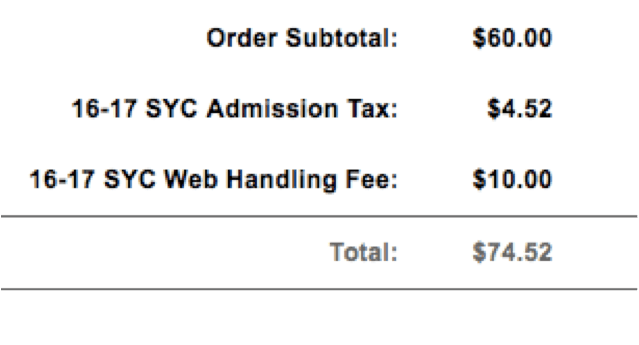
Price-based taxes are easy to manipulate. For instance, North Carolina’s new 7.5 percent sales tax on tickets (“admission charges”) is getting eroded by an affiliate of the state, the UNC-Chapel Hill repertory theater.

When you order tickets, the theater separately states a ‘Web Handling Fee” that is not taxed. Here’s what an order looks like:

prc Continue reading “UNC erodes NC sales tax”

Humboldt OKs 7-acre grow

When I went to Humboldt County in 2015 to find facts for the California Blue Ribbon Commission, I heard informally that a marijuana grow of 10,000 square feet was enough to make a decent living. So that figure was bandied about as a hard cap – as a way to share the wealth that was about to open up. https://newrevenue.org/2015/08/23/sharing-the-wealth-from-legalization/. Being friends with a lot of Democratic Socialists, I’ve been interested in sharing the wealth, and thinking smaller farms would be an experiment in that direction.

Ten thousand square feet, about a quarter of an acre, was the smallest area I heard, but one acre is the hard cap in Proposition 64, the recreational legalization initiative to be voted on in November, (That acre limit sunsets after a handful of years.)  [UPDATE:  A friend in California indicates that the initiative allows one person to own several grow licenses.  So the only remaining hope for spreading wealth is that regulations will cut back on the ability to have multiple licenses.]

Here’s what the Blue Ribbon Commission said about capping production: Continue reading “Humboldt OKs 7-acre grow”

St. Pierre steps down

We came from different directions. Allen St. Pierre, who is stepping down as head of NORML, the cannabis consumer lobby, wanted to legalize marijuana for consumers; I wanted to raise revenue from something whose externalities were less positive than, say, wages paid to workers, which we tax so widely now — while we say America’s most important issue is jobs.

Allen figured that when marijuana got legalized, the public would get a cut. I figured the public would get nothing from cannabis unless the government tolerated it. Continue reading “St. Pierre steps down”

State Universities to grow marijuana

“Louisiana State University and [HBCU] Southern University want to begin growing marijuana for medical use. The boards of both schools approved plans Friday to pursue licensing, making them the sole growers and researchers for the state, The Associated Press reported.” The source is here.

LSU’s vice president for Agriculture “said university officials believe they can meet security requirements and retain federal funding. He said LSU could become a leader in research on the medicinal properties and cultivation of marijuana.”

Objections to states getting in the marijuana business are looking weaker.  Continue reading “State Universities to grow marijuana”