Marijuana and Tobacco Laws — Rachel Barry’s Comparison Chart

Rachel Barry, a policy scholar at UC-San Francisco’s Center for Tobacco Control Research and Education and my colleague on the California Blue Ribbon Commission on marijuana legalization, has prepared this extensive chart or table comparing marijuana laws and tobacco laws.  To see it easily, click on Rachel Barry MJ policies April 17, 2015; a downloadable Word version is Rachel Barry Word MJ policies April 17, 2015.   I think it’s very useful.  The pasted version below gives you an idea, but you will probably need one of those links to see the whole thing.  (This chart is her work in progress, not that of the Commission.)

She welcomes feedback, and hopes to provide updates as laws change. Please contact her directly with suggestions, corrections, questions, and updates: email:rachel.barry@ucsf.edu,  I’ll try to keep up with her.  (Thanks, Rachel, for letting me post this.) Continue reading “Marijuana and Tobacco Laws — Rachel Barry’s Comparison Chart”

Reasons for a Jet Fuel Tax

1.  Environmental — marginal pressure on carbon

2.  Progessive — wealthy and corporations are the primary stakeholders.  The housekeepers’ unions at the airline hubs may be the voices for the exception that proves the rule.

3.  I’d even be for a higher gasoline tax, and it’s regressive.  Poor folks drive farther to work than rich folks, who can afford to live in the middle of things.

++++

The jet fuel tax may be low hanging fruit, a sitting duck, underbrush — consensus item.  The kind of thing you put into a bill or package that a majority will sign off on.  Tax Reform, if it follows the 1986 model, would make hundreds of changes to the Tax Code.  Maybe it won’t happen.  But it won’t happen without a list.


In progress — comments welcomed.

Voucher privitization of growing privileges

UPDATED 14 May 2015:  I disparage the option of  Voucher privatization in this article more than I would now. Voucher privatization might be too unwieldy to work on a state level, but it’s conceivable on a county or sub-jurisdiction level.

+++

Tax folks like to work through theory.  So here’s a here is a trip to Theoryland, designed to exhaust the options for allocation of the privilege to sell marijuana commercially.

Maybe a state will say not everyone can grow marijuana commercially. If a state makes that decision (whether it should limit growing is not the subject here), how might the privilege to grow and sell marijuana be allocated? By lot, on the merits, by growing history, by charging steep fees, by annual auction, or how?  I’ll get into those options later.  Voucher privatization is a democratic model for sharing the wealth. OK, it’s not practical, certainly not in the short term.   Continue reading “Voucher privitization of growing privileges”

Humboldt trip

TourGroupPhoto try 2

Fact-finding trip to growing country, Humboldt County, California, with elected state officials and staff, thanks to http://cannabisvoice.org.  Write-up at http://cannabisvoice.org/cannabis-industry-hosts-2-day-taxation-excursion/.  I’m at top right.


280E and square feet — Arkley

Having doubted that square footage (or canopy) fees or taxes could be deductible under 280E on the federal income tax return of a cannabis-growing business, I asked Todd Arkley, a Washington State CPA with a lot of cannabis clients. Todd knows more than I hope ever to learn about tax accounting.  Whether you call a payment based on square footage a tax or a fee, he makes the case that it is deductible.   Continue reading “280E and square feet — Arkley”

Arcata Electricity Tax — Guest Post

GUEST POST from a California observer of Arcata’s electricity tax. The writer, whom I thank, asked to remain anonymous. I don’t necessarily agree or disagree with opinions in the post, but find it thorough and thoughtful.  And whatever you think of an electricity tax, Arcata’s tax seems to have glitches.  Here is a better-formatted version:  Guest-post-from-a-california-observer-of-arcata_s-electricity-tax

PO

++++++++

Guest: I’ve copied below a little essay I [the Guest Poster] wrote last year regarding what the nuts-and-bolts of this tax look like in terms of cultivation, and if it were applied to the rest of the county, what that looks like in terms of cultivation. Continue reading “Arcata Electricity Tax — Guest Post”

Penalizing MJ electricity

Indoor marijuana grows are notorious consumers of electricity.  Following the lead of Arcata, California, which collects a 45-percent tax on excess electricity consumption, Boulder County, Colorado, is taxing electricity use of marijuana grow operations by the kilowatt-hour:

“Boulder County will levy a charge of 2.16 cents per kWh on all electricity consumed by marijuana growers, which works out to about $100 extra for each kilogram of finished pot. Continue reading “Penalizing MJ electricity”

OR taxes too high?

[Oregon] State Rep. Carl Wilson . . .and other lawmakers struggle to figure out how to tax pot without driving sales underground. . . .

“It is becoming clear that the 800-pound gorilla here is taxation,” Wilson said. “Many members of the committee are deeply concerned with marijuana products being taxed out of the market, making everything we have done useless.

Continue reading “OR taxes too high?”

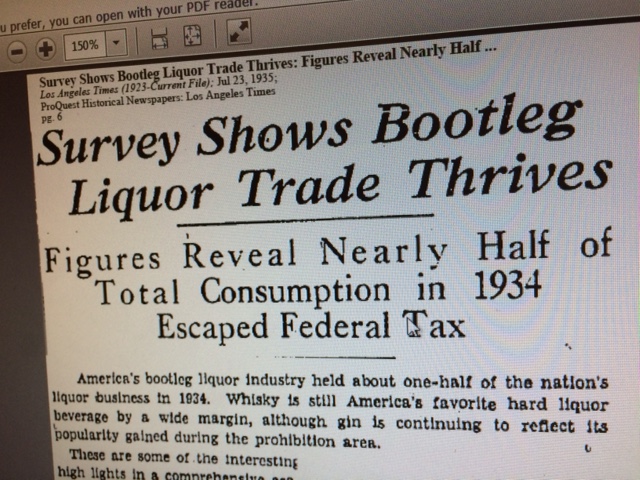
FDR and alcohol tax

Quotes from FDR team on re-imposing alcohol tax in late 1933, with the message of start with low taxes:

Topic (sentence fragment): “The assurance by tax adjustment and other means of an adequate supply of inexpensive legal alcoholic beverages which will be able to drive out the illegal competing production by price competition.”

Discussion: “The attempts to control this illegal industry solely by policing the production and sale of illegal alcoholic beverages have not been wholly satisfactory. The enforcement problems of the prohibition period will still remain in those States which continue to be dry after the repeal of the eighteenth amendment. It is believed that the price of legal liquor to the ultimate consumer in the post-prohibition period will be one of the important factors in determining the success or failure of the general effort to eliminate the illegal industry.” Continue reading “FDR and alcohol tax”

Sovereign Tribes?

Native American Tribes in what the Department of Justice calls “Indian Country”  are like sovereign nations, so they can set up systems to allow the sale of marijuana, says the Federal government.  Over 100 Tribes are looking into selling it.

So can a state erect a roadblock and inspect everyone coming out, as a nation can at its international border?  I imagine there is learning on that question, but I have no idea.  Those are questions of federalism or Federal-Tribal law or something that are beyond a tax man.  I know enough to conclude that warrantless federal searches are OK at our borders with the sovereign nations of Canada and Mexico.  But can a state conduct them ever?

And can warrantless searches be effective? Tribal land reportedly is sometimes so remote as to make smuggling across international borders relatively easy.


280E Conformity — with CA update

States that have income taxes (not all do) and that legalize marijuana face an arcane income tax issue:   280E conformity. Simply put, should marijuana businesses, on their state income tax returns, be able to deduct all expenses? Federal section 280E, discussed a good bit at www.newrevenue.org, allows businesses in violation of federal narcotics laws to deduct only cost of goods sold – and not, for instance, selling expenses.  Many state income tax laws track — conform to — the federal tax Code.  That’s why, when you fill out a state tax return, much of the data you need to enter peels off the federal return.

In Oregon, before the 2014 marijuana initiative, state tax law conformed to 280E — it followed the federal tax Code.   Then Measure 91 repealed the state’s version of 280E across the board. Now critics are saying repeal should apply only to marijuana – not to all federally illegal drugs, such as meth and heroin.  Good catch, I suppose, so long as Oregon voters are mad at other drugs.

In California, there is 280E conformity for individuals but not for corporations.  (Huh?)   Continue reading “280E Conformity — with CA update”

Cigarette tax %

In the USA, government gets 60.3 percent of the total price, while the private supply chain gets 39.7 percent. Or the total government take is 152 percent of what the private sector gets.  In Europe, the comparable numbers for government are around 80 percent, and 400 percent.

U.S. numbers are calculated from: “A cigarette pack today fetches roughly $2.50 at the factory gate, on which government collects $3.80 on average Continue reading “Cigarette tax %”