A Colorado poll asked, “What has been the greatest benefit of legalization?” — and got these answers:
If you can’t see the image: Continue reading “Taxes Help Legalization”
A Colorado poll asked, “What has been the greatest benefit of legalization?” — and got these answers:
If you can’t see the image: Continue reading “Taxes Help Legalization”
Supplemental Thoughts about Revenue from Marijuana in Vermont, 16 January, 2015 in pdf, by Pat Oglesby, supplements “Considering Marijuana Legalization: Insights for Vermont and Other Jurisdictions,” a RAND Corporation Report issued January 16, 2015. That Report is here: http://www.rand.org/pubs/research_reports/RR864.html and here: Considering Marijuana Legalization, RAND, 16 January 2015
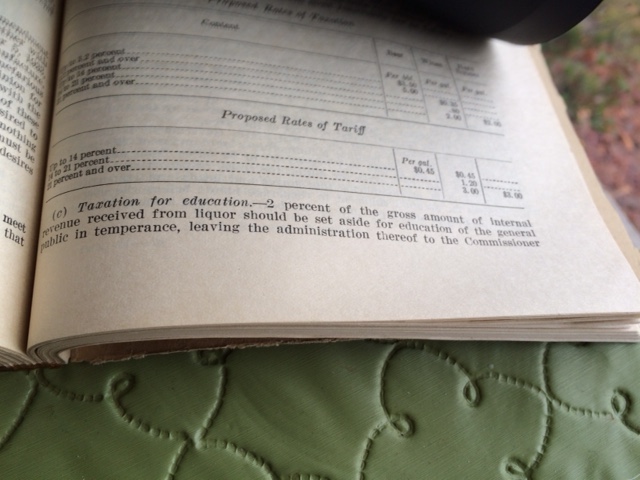
The Federal Bar Association of New York, New Jersey, and Connecticut urged that 2 percent of new federal liquor taxes go for temperance education – from page 301 of Tax on Intoxicating Liquor, Hearings Before the Committee on Ways and Means, House of Representatives and the Committee on Finance, United States Senate, 73d Congress, Interim, 1st and 2d Sessions (Dec. 11-14, 1933). (Carryover page says “of Education.”)
The economic conditions of the Depression did not allow that diversion of revenue. But some of Washington State’s tax on marijuana does go for temperance education.
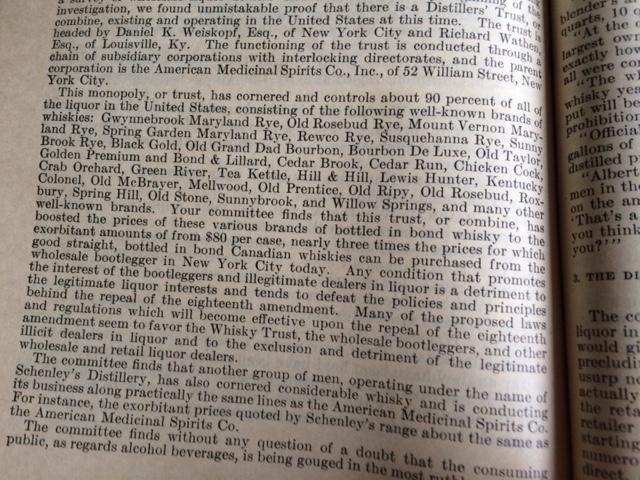
Lewis Landes, lawyer for the Wholesale Liquor Dealers Committee of New York City, accused a “Distillers’ Trust” of keeping legal prices to wholesalers “exorbitant” — about three times the black market price. This is from page 296 of Tax on Intoxicating Liquor, Hearings Before the Committee on Ways and Means, House of Representatives and the Committee on Finance, United States Senate, 73d Congress, Interim, 1st and 2d Sessions (Dec. 11-14, 1933).
Nearly 90 minutes of video here, (URL https://vimeo.com/111873073). On left, Secretary of Administration Jeb Spaulding; on right, Dr. Beau Kilmer of RAND. Press report Here (URL http://wamc.org/post/vermont-holds-statewide-hearing-marijuana-legalization-report).
Ayn Rand did not think the state would wither away to nothing, as Marx suggested, but saw that some government would exist, and need to be paid for.
She suggested commercial transactions as a major possibility for revenue. Credit transactions (and thus financial activity) would be prominent sources. Excerpts from Chapter 15 of The Virtue of Selfishness:
There are many possible methods of voluntary government financing. A government lottery, which has been used in some European countries, is one such method. There are others.
As an illustration (and only as an illustration), consider the following possibility. Continue reading “Ayn Rand on government finance”
I’m happy to announce that my friend and retired tax expert LaBrenda Garrett-Nelson has joined the Board of Advisors of the Center for New Revenue. LaBrenda and I worked together for the Joint Committee on Taxation in the 1980s, where she Continue reading “LaBrenda Garrett-Nelson Joins Board”
Oglesby Marijuana NCSL dec 12 6am slides — final for panel of December 12, 2014.
An IRS ruling has changed everything and made most of the post below obsolete. More here or at https://newrevenue.org/2015/08/02/whats-next-for-280e/
+++++++
Start here:
“States could unilaterally correct this problem by changing the type of taxes they place on the marijuana industry. IRS treatment of sales taxes depends upon how a state defines the tax. If the state defines the tax as being levied on the seller, the tax is included in gross receipts. On the other hand, if the tax is defined as levied on the buyer, the seller is treated as a mere collector custodian of the state’s revenue and the amount levied is not properly included in gross receipts. For most businesses this is a distinction without a difference; sales taxes levied on a seller can be deducted as an expense. However, for dispensaries denied deductions by § 280E, this distinction could reduce federal tax exposure by huge amounts. Creative legislators could even redefine license fees as custodial sales taxes, by requiring retailers to collect the license fees from consumers instead of charging them directly to retailers.”
New explanation at http://taxfoundation.org/blog/one-simple-state-tax-code-tweak-favor-marijuana-taxpayers-over-tax-evaders?mc_cid=a792bd624c&mc_eid=c12785538d
“Such redefinition wouldn’t lower a state’s marijuana tax income, but might instead increase tax revenues by helping to level a playing field artificially tilted toward the tax evading black market alternatives § 280E was intended to punish.”
+++++
Thanks to Chris Law for sending that — author is James W. Kennedy.
+++++=
Now for a tacked-together agglomeration of all I could find. (Notes for an article, maybe.)
The recent WA fix shifting tax burden from seller to buyer is in section 205 on page 8 here, or at http://leg.wa.gov/Senate/Committees/WM/Documents/2136%20AMS%20-%20S-3153%201.pdf. That’s the buyer pays approach (Nebraska sales tax rule), mentioned at the end. TAM withdrawal is noted below. 280E and canopy taxes are discussed here or at https://newrevenue.org/2015/04/15/280e-and-fees-arkley/. That this problem exists, and has not been fixed everywhere, shows the primitive state of marijuana tax design. Not deducting taxes is as primitive and zany as taxing by price, railed at and disparaged here. I myself let this deductibility issue slip a long time. It was such a crazy result, I didn’t think it possible.
THE STORY: Maybe a quick and tiny tweak to Washington’s state marijuana excise tax statute (and similar statutes in other states) could save businesses a lot of federal income tax under 280E, which lets federally illegal drug sellers deduct only cost of goods old. Now I kind of like 280E, insofar as it prohibits deductions for advertising, marketing, point-of-sales displays, and the like (disfavoring those activities in a way that does not allow any argument about freedom of speech), but can’t imagine why federal taxpayers shouldn’t be able to deduct state excise taxes. The industry complains mightily about 280E, but getting Congress to fix tax problems, or to help the marijuana industry, is not the work of a moment.
Luckily for the industry, no federal fix seems needed for this one signficant part of the 280E problem. The Washington Legislature (and Legislatures of other states with the same problem) should be able to make excise taxes federally deductible with the stroke of a pen, I think, and try to explain below.
And maybe a quick fix is possible. The Legislature has already shown it can act expeditiously to fix the Washington marijuana statute: “During the 2014 Legislative Session, I-502 was amended to explicitly allow the sale of extracts and concentrates.” http://liq.wa.gov/marijuana/faq_rules — that link is busted: Try http://lcb.wa.gov/mj2015/faqs-rules. Cutting the federal tax bill of a marijuana industry that’s struggling to beat the black market, at zero cost to the state, seems like an easy fix that might sail through on its own – even less controversial than allowing concentrates.
Here’s more:
Continue reading “State law fix for 280E problem? Update 13 August 2015”
“I had a store owner in Colorado tell me that only chumps and tourists go to the [taxed] recreational side” of marijuana businesses rather than the tax-free medical side, Seattle City Attorney Pete Holmes said. http://www.usatoday.com/story/news/nation/2014/09/26/washington-marijuana-legal-scarce/16266573/
[UPDATE 22 December 2014: Extension of the Holder memo to Native American territory opens the distinct possibility of monopolies there. And the case of Nebraska v. Colorado gives the Supreme Court a chance to address Legality (of a lesser provocation) and Standing.]
You hear folks say states can’t run a marijuana monopoly because they would be ordering employees to violate federal law. I’m not so sure. First, a monopoly is not indisputably illegal. Second, no one other than the federal government may have standing to complain.
I. Legality
The CSA’s definition of the term “person” – possible violators – does not include states of the Union. http://www.deadiversion.usdoj.gov/21cfr/21usc/802.htm Continue reading “State marijuana monopoly? — Updated December 22, 2014”
“The California midterm election also saw more than a dozen local pro-medical marijuana initiatives fail in the state — even though every proposed medical cannabis tax passed.” Story here and at http://www.eastbayexpress.com/oakland/green-lit-california-legalization-measure-is-a-go-for-2016/Content?oid=4127974
Federal Excise Taxes — Lowry is a good introduction to the field. I learned some things, like this example:
ad valorem taxes imposed at the manufacturer’s level could provide an incentive for value-added options to be ordered further down the supply chain in an attempt to minimize the tax burden. For example, the manufacturer tax on firearms is levied on the assembly of a complete rifle, but any add-ons or modification kits to that rifle are not taxed.
Continue reading “Introduction to Excise Taxes, by Sean Lowry of CRS”
A video of the November 18, 2014, Rhode Island panel on marijuana legalization is here: (http://www.rifuture.org/regulate-ris-marijuana-forum-packed-with-information.html). In the second panel, the lower video, I come in at about the 18’20” mark with comments about how collapsing pre-tax prices might create problems. Other panelists are Michelle McKenzie, Senator Josh Miller, and Mason Tvert. Jared Moffatt moderates.
Oops. The detailed analysis of the economics of a federal marijuana tax by the Congressional Research Service (Gravelle and Lowry) cites an article of mine for the proposition that “state monopolies for marijuana production or distribution cannot occur while it is still illegal at the federal level because state governments cannot force the employees of such hypothetical operations to engage in the marketing of a drug that is illegal at the federal level. See Pat Oglesby, ‘States May Be Stuck with Second-Best Marijuana Taxes,’ State Tax Notes, June 2, 2014, pp. 539-544.”
I wrote that, but I now see a possible path to state marijuana monopoly. The doctrine of judicial standing means that if you violate federal law, I probably can’t sue you (and I can’t sue the federal government either). So if you are not paying your taxes, or if you are falsely claiming disability benefits, I can’t take you to court. I can turn you in, or tell the press. It’s up to the federal government to enforce the law.
Substitute “a state” for “you” in that thinking and you kind of get the doctrine of standing. A state that violates a federal law is not subject to Citizen’s Arrest. If the federal government lets the violation go, the courts probably will, too.
A difficult path. More to come.
Jane Gravelle, whom I remember from the 1980s as a true tax professional, and a colleague named Sean Lowry have issued a report on marijuana taxation here (http://fas.org/sgp/crs/misc/R43785.pdf), It’s more economics than law, and I don’t agree with some of it, but I feel like the field of folks looking at the minutiae of marijuana tax design has expanded. I think that’s good for America.
If the government wrote a check to every church’s minister, that would be Establishment of Religion, right? Then what about tax breaks for every minister? Code section 107 gives tax breaks for housing to any “minister of the gospel” (expanded in Regs to cover rabbis, imams, etc.). If that’s not the kind of caught-red-handed establishment of religion the Founders forbade in the 1st Amendment, what is?
But the Seventh Circuit found yesterday that plaintiffs challenging the tax break for “ministers of the gospel” in Code section 107 lacked standing to sue. No particular personal injury Continue reading “Religion remains established for lack of standing”