Revenue from a post-280E marijuana tax: Gross and net

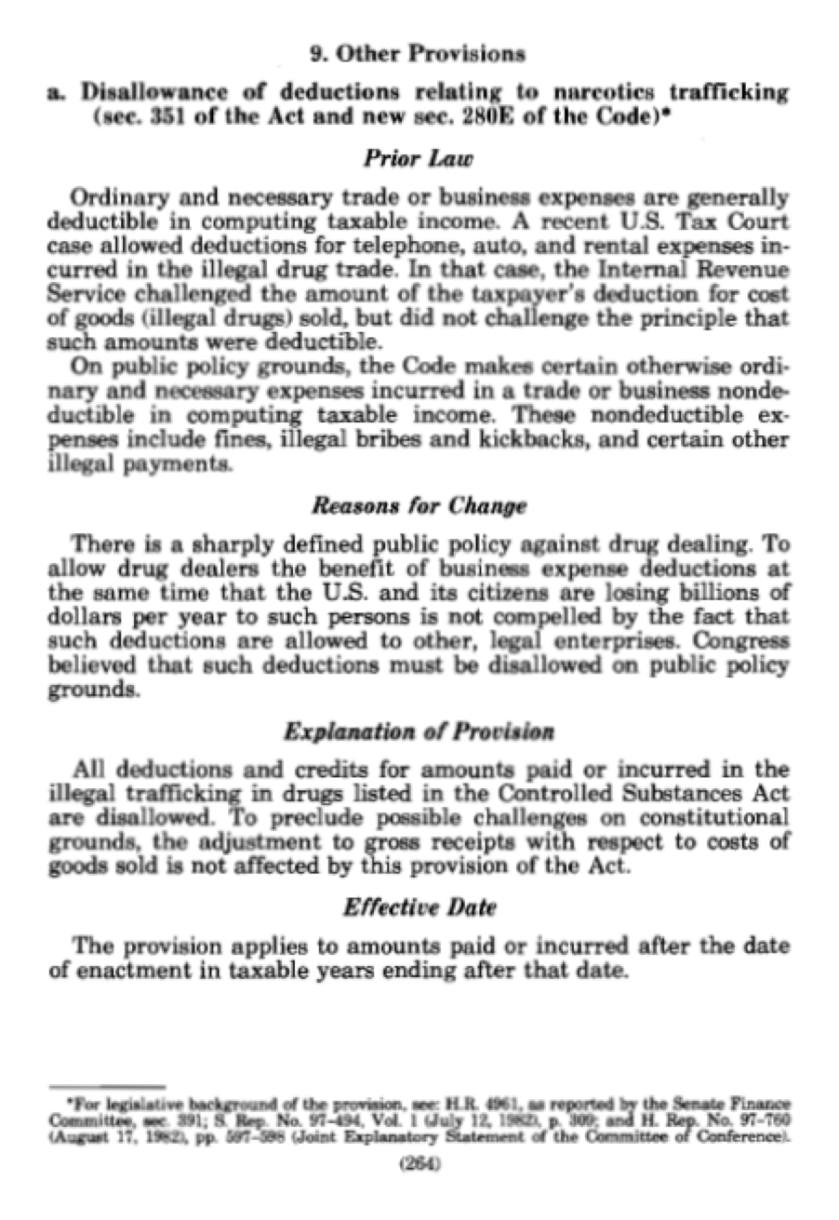
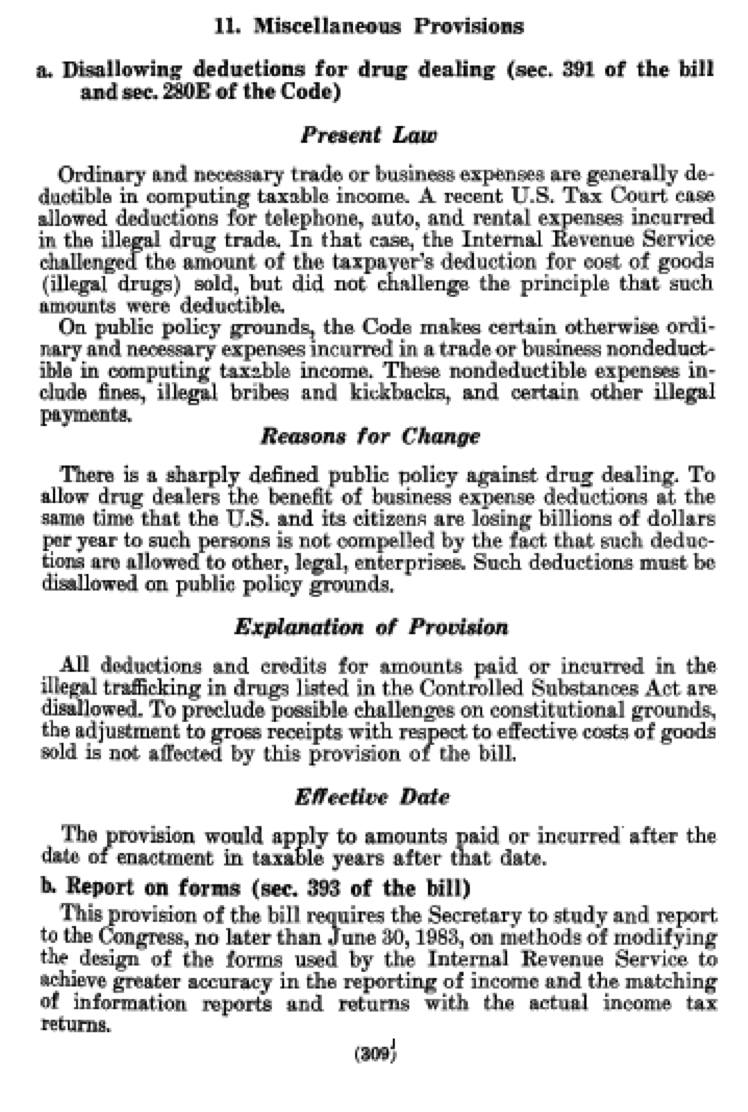
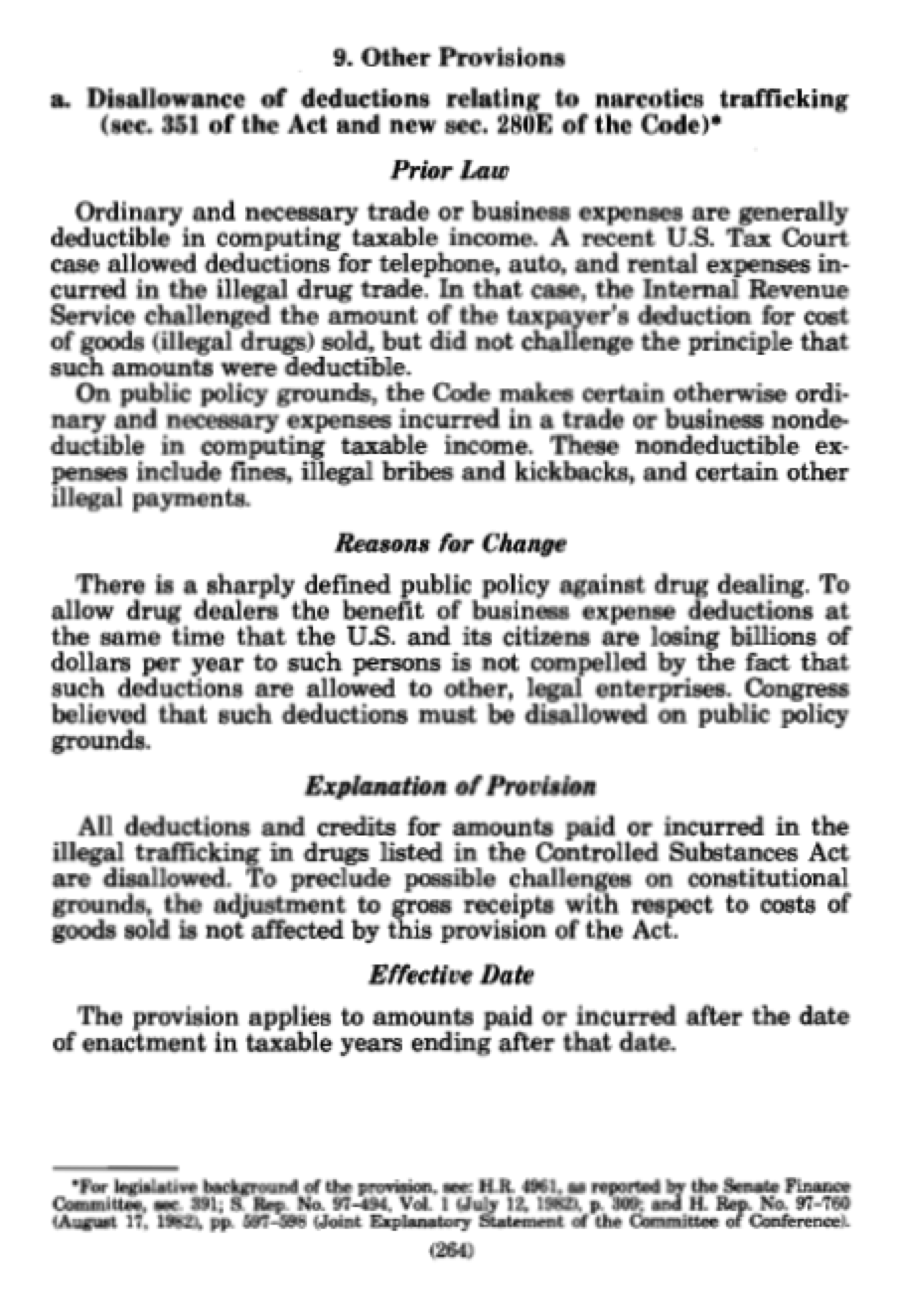
I’ve written that federal and state revenue from taxing marijuana could be as much as $25 billion a year. http://www.huffingtonpost.com/pat-oglesby/a-way-marijuana-dilemma_b_2490720.html.  But a revenue estimate for a new marijuana tax would presumably involve revenue loss from repeal of unpopular section 280E, which disallows deductions for all expenses other than cost of goods sold.  Repeal of section 280E could be costly.

Marijuana Tax: An Unintended Consequence of 280E – Fragmenting the Industry?

Premise:  A fragmented industry is harder to supervise and regulate.

Here’s what may be a counterproductive incentive of 280E.  Say Mom and Pop operate a marijuana business: Continue reading “Marijuana Tax: An Unintended Consequence of 280E – Fragmenting the Industry?”

Marijuana tax thinking: Still in its infancy

A property tax on marijuana trademarks and patents seems almost impossible to administer.  Figuring the value of those intangibles requires estimating the income they would generate, in a circumstance of total uncertainty.  But Washington State House Bill 1976, just introduced, would impose a tax of $3.60 per $1,000 “of assessed value Continue reading “Marijuana tax thinking: Still in its infancy”

Tax legislative lingo: Rush to recede

In Congressional Conference Committees reconciling House and Senate tax bills, in the 1980s, at least, staffs worked through spreadsheets listing conflicting provisions and the evolving state of play as  the two Houses gradually came into agreement.

The typical state of play early on went something like this for a particular provision:  House position:  Senate recedes.  Senate position:  House recedes.  Neither side

Continue reading “Tax legislative lingo: Rush to recede”

Tax legislative lingo: Underbrush

Back when I worked for Congress, 1982-90, tax legislation — or negotiations in Congressional Conference Committee — often started with what staff called “underbrush” — pieces of a bill that everyone could agree on.  “Everyone” meant six or seven groups:  majority and minority staffs of Ways and Means in the House and Finance Continue reading “Tax legislative lingo: Underbrush”

China’s Carbon Tax

As a tax policy person, it’s heartening to see China reportedly preparing to tax carbon “proactively,” while America can’t enact the weak substitute, cap and trade.  The leading Chinese paper gets into the economic effects, but doesn’t get to the heart of the matter, tax evasion.  Still.  That paper is “The Design on China’s Carbon Tax to Mitigate Climate Change.”  “On” is not a typo:

Continue reading “China’s Carbon Tax”

Colorado panel recommends new marijuana tax

Having worried that Colorado’s Amendment 64 probably tended to undertax marijuana in “Gangs, Ganjapreneurs, or Government: Marijuana Revenue up for Grabs,” 66 State Tax Notes 255-269 (October 22, 2012), online at http://ssrn.com/abstract=2165864, I’m glad to read about a new-starter tax, though the details remain to be seen:

(From Jacob Sullum:) The Denver Post reports that the task force wants marijuana to be heavily taxed. Continue reading “Colorado panel recommends new marijuana tax”

Best Marijuana Tax Plan Yet From An Elected American — WA 2013

“Setting tax rates in the initiative [was] unwise and inflexible. We should reconsider this approach and allow the LCB [Liquor Control Board], in partnership with the state Department of Revenue, to have the flexibility to adjust tax rates in a more real-time fashion for the first few years in order to prevent under or overpricing the newly available product. Comments at various citizen meetings have loudly complained that the rates are too high and too low to prevent or respond to black markets. We don’t know yet. But we can be assured that without flexibility we are unlikely to adjust rapidly to vital market dynamics.”

That’s from the Chair of the Washington State House Finance Committee,  Continue reading “Best Marijuana Tax Plan Yet From An Elected American — WA 2013”

Indexing: Oregon’s marijuana bill doesn’t get it.

A sustainable tax based on weight or volume needs to be indexed for inflation.  A new marijuana legalization bill in Oregon, House Bill 3371, fails that test.  http://www.leg.state.or.us/13reg/measpdf/hb3300.dir/hb3371.intro.pdf.  The tax rate, $35 per ounce, can’t be proved wrong — or right.  But the history of alcohol taxation in recent years, where unindexed taxes have lost over half their real value since 1992, proves the value of indexing Continue reading “Indexing: Oregon’s marijuana bill doesn’t get it.”

Marijuana tax indexed: Maryland bill gets it

Delegate Curt Anderson’s Maryland House Bill 1453 to legalize marijuana imposes a $50 per ounce tax on sales to retailers, and then goes on to include as tax: “An amount that the comptroller may set that adjusts the initial $50 per ounce rate for inflation or deflation based on the consumer price index.”  http://mgaleg.maryland.gov/2013RS/bills/hb/hb1453F.pdf

Indexing is essential Continue reading “Marijuana tax indexed: Maryland bill gets it”

North Carolina sales and services tax — a reaction

Here is a comment emailed from a North Carolina tax lawyer:

One analysis puts the [required sales tax] rate between 10-11%.  The more seepage they have in the base, the higher the rate would have to go. Services are easier to obtain for cash (house cleaning, yard work, house painting, etc.) and some can be more easily acquired in cross border activities or electronically where compliance is sketchy. Continue reading “North Carolina sales and services tax — a reaction”

NC sales and services tax proposal runs into more trouble

“[A] swap from income to sales taxation . . . in North Carolina . . . would require sales tax revenue to increase from 1.8 percent to 4.9 percent of state personal income. With the same sales tax base, North Carolina would have to raise its sales tax rate from 5.75 percent to 15.9 percent. With base broadening that would increase the implicit sales tax base to 50 percent of personal income, the rate would have to rise to 12 percent.” Martin A. Sullivan, http://taxprof.typepad.com/files/138tn0789.pdf.

I can’t vouch for those numbers, but I have no reason to doubt them.  It remains hard to imagine the Legislature will adopt such a radical proposal.

Federal Marijuana Tax Bill from Congressman Blumenauer — Is the tax burden just right?

Any marijuana tax needs to be low enough to drive trade into legal channels.  That may happen under a bill from Oregon Congressman Earl Blumenauer, which would “create a federal marijuana excise tax of 50 percent on the ‘first sale’ of marijuana – typically, from a grower to a processor or retailer.” Continue reading “Federal Marijuana Tax Bill from Congressman Blumenauer — Is the tax burden just right?”