The California Blue Ribbon Commission report on marijuana legalization is here or at https://www.safeandsmartpolicy.org/wp-content/uploads/2015/07/BRCPathwaysReport.pdf. The major tax part starts on page 48, but there is some tax material scattered throughout. I don’t agree with all of it, but I’m delighted to have been part of the Commission.
Oregon tax cut linked to 2,302 deaths
A few years ago, the economists Gregory DeAngelo and Benjamin Hansen wrote a paper looking at road deaths and injuries in the state of Oregon, which—in part because of a “tax revolt”—has cut the size of its highway patrol repeatedly since the end of the nineteen-seventies. “We find that Oregon would have experienced 2,302 fewer fatalities from 1979-2005 if the number of state police had been maintained at their 1979 levels,” the two concluded. Continue reading “Oregon tax cut linked to 2,302 deaths”
Alcohol taxes save lives
From the May 4, New Yorker:
There is also a clear, demonstrated relationship between the cost of alcohol and the number of drunk-driving deaths. Research has shown that raising social awareness around drunk driving—as groups like Mothers Against Drunk Driving have done—is not enough. In most Western European countries, the sales tax on alcohol ranges between sixteen and twenty-five per cent. In the United States, it is somewhere between one-half and a third of the European rate—and because the federal excise is a flat amount (not a percentage of the sales price) it falls every year with inflation.
“There are extremely negative outcomes that are responsive to the price of alcohol, like highway fatalities,” the economist Philip J. Cook, who has written extensively on the subject, says. “I estimated that the tax increase associated with the 1991 excise tax saved sixty-five hundred lives the first year from trauma-related accidents of various kinds. It was an extraordinarily effective measure from the public-safety perspective. Continue reading “Alcohol taxes save lives”
Don’t even THINK about taxing soda
Opponents of taxes don’t lack for arguments. Here’s an especially creative one, against proposals to tax sugary drinks: The very debate about the tax will be a waste of money – a “social cost”! Seriously.
Here is what Professor William Shugart, II, wrote in the Wall Street Journal:
“Wasteful rent seeking by advocates and adversaries of a selective tax can swamp its social benefits, if any. Suppose that a proposed tax is expected to raise $1 million in revenue over the medium term. Producers and retailers of soft drinks will be willing to spend up to $1 million to block the tax from being enacted; groups supporting programs financed by the revenue also will spend money to pass the tax. So, if $1 million (or more) is invested in lobbying, that sum is transformed into a social cost, which must be added to the already-heavy burden that every tax creates.” Continue reading “Don’t even THINK about taxing soda”
Swift’s Sex Tax and Stated THC
It’s hard to measure THC in bud or flower accurately enough to tax. Take a look at some of the science here.
But you might tax what sellers say is the THC content of their product.
Here are three examples of how government can tax claims, false or true: The old book income AMT, the stated THC tax for cannabis, and the Swaggering Stud tax in Gulliver’s Travels.
Let’s start back in 1727, with the “Swaggering Stud” tax. In Gulliver’s Travels, Gulliver listened to a “professor” who proposed this plan: The “highest Tax was upon Men who are the greatest Favourites of the other Sex, and the Assessments, according to the Number and Nature of the Favours they have received; for which, they are allowed to be their own Vouchers.” Decode the olde English, and you’ve got a tax on either promiscuity or boastful lies about sex.
You don’t care about the truth of how the Number and Nature of Favours received. The tax base is the claimed Favours. So the boastful liar gets taxed just like the truthful Casanova. Understating Favours received equals modesty, which Swift might approve of. So unreported Favours aren’t taxed.
OK, Swift was a satirist. But the approach of taxing claims, rather than something you can count and audit, is worth a look.
There’s precedent. There was once a federal alternative corporate minimum tax on “book” income — the income corporations reported to shareholders. The idea was that corporations couldn’t have it both ways – telling shareholders they were profitable, and telling the federal government they weren’t. So they were taxed on what they told shareholders – despite federal tax breaks and loopholes.
Continue reading “Swift’s Sex Tax and Stated THC”
Taxes in Gulliver’s Travels — New HuffPo piece
In Gulliver’s Travels, Jonathan Swift ventured into tax theory; here is a HuffPo piece, or http://www.huffingtonpost.com/pat-oglesby/taxes-cannabis-gulliver-j_b_7761696.html?utm_hp_ref=tw, that goes into his look at taxing Vices and Folly (a framework I use to analyze cannabis taxes), and more.
Tax Evasion in Greece
Here’s a chart that’s causing a lot of consternation and misinterpretation: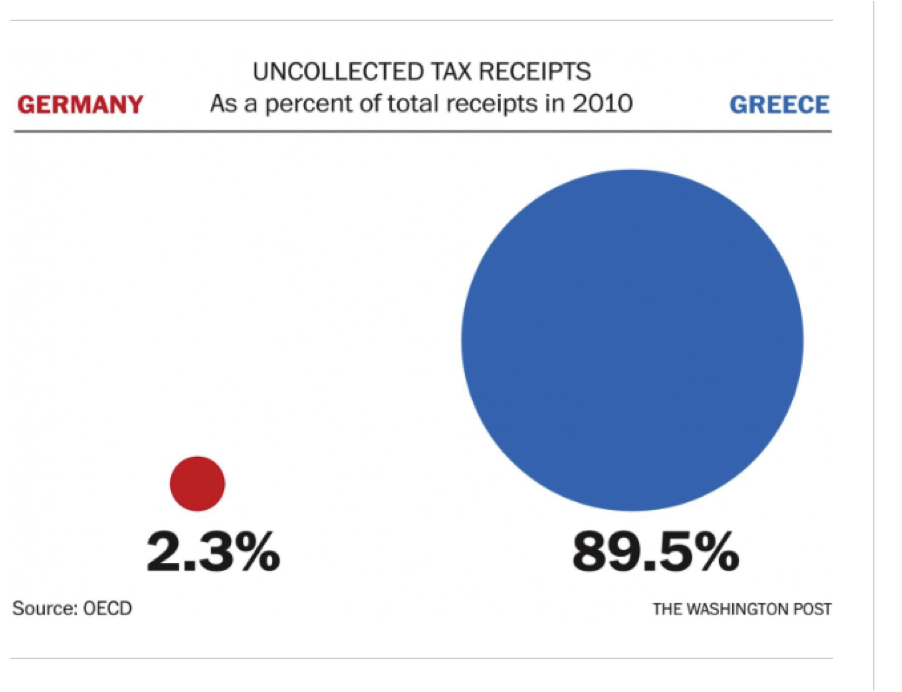 from https://www.washingtonpost.com/blogs/wonkblog/wp/2015/07/03/why-greece-and-germany-just-dont-get-along-in-15-charts/?hpid=z1
x/y = .895. So uncollected receipts are nearly as big as collected receipts. If collected receipts are 100, uncollected receipts are 89.5, right?
If you believe that, Greece collects only a little over half (100/189.5) of what is due? But wait!
Bill Turnier sent me here, or http://www.bbc.com/news/magazine-33479946: The numerator seems to be all outstanding uncollected taxes, from years and years — not just the current year. Continue reading “Tax Evasion in Greece”
Colorado’s bud tax $0.61/gram — Updated 12:53 p.m. July 13, 2015
Colorado’s so-called-but-not-really 15 percent producer tax on non-medical cannabis, starting July 1, is 61 cents a gram for bud, and 10 cents a gram for trim. Colorado actually taxes cannabis at the producer level by weight, though its Constitution requires a 15-percent excise tax at the producer level. (It’s disheartening when reports overlook the actual tax method, though many do, even now.) This weight tax is supposed to reflect previous prices. Since the weight tax has reached its all-time low, previous prices have, too, the State indicates.
Those per-gram numbers are calculated from non-metric numbers in the chart below, which comes from the state. You take 15 percent of the “Rate,” and divide by 453.592, the number of grams in a pound. Colorado’s tax on bud started at 62 cents, rose briefly to 66 cents, and now is at 61 cents through the end of 2015. Continue reading “Colorado’s bud tax $0.61/gram — Updated 12:53 p.m. July 13, 2015”
Grow cannabis in land grant universities?
In 2013, I gave an hour-long talk on marijuana legalization for the North Carolina Bar Association. I recall that when I suggested that our land grant university do the growing, one man literally walked out – as if to say, “That’s so far-fetched that I don’t have to listen to this nonsense any more.” (Maybe that’s not why he left, but he was muttering something.)
Well, in Louisiana, state universities are in line to grow cannabis, by statute. That sounds like a good idea — if you take the RAND view that government sellers are likely to be among the least interested in creating demand. Get the agriculture school, and the botanists, and the chemists, and the public policy people, and the medical school, and the law school, and maybe even the business school to figure this out. Put the grow area on public access cable, 24/7.
If you want a safe provider of cannabis, a land grant university would look to be at the top of the list. In Louisiana, that means LSU and HBCU Southern University. Here’s the statutory language: Continue reading “Grow cannabis in land grant universities?”
What should Greece tax?
What can you tax in a populace that distrusts government (as our Founders intended) but then goes overboard, and undermines it? That is, what can government find and measure, in such a way that the public can trust that the tax is being paid?
Some countries, like Finland, go so far as to publish income tax payments, which are posted online by newspapers. That’s transparent.
Our standard local property tax can be pretty transparent. The tax value of property in many states is a matter of public record, and on the internet. Folks who don’t pay get their names put in the paper, and maybe their property sold at auction. There is the possibility that some government official is colluding with taxpayers to undervalue property, or count phantom payments, bills, but that seems like a minor worry in the United States. I feel like property tax corruption is not a huge problem.
Payments of cannabis taxes in Washington State are on the public record. Continue reading “What should Greece tax?”
Fees in CO & WA
Colorado’s license fees are considerably higher than Washington’s, with charges
between $2,750 and $14,000 with an additional $5,000 application fee for new
businesses. Washington charges only $250 to apply and $1,000 per year for a
marijuana business license. — Stanford paper.
Licenses
“Licenses are also highly flexible when compared to sales or excise taxes because as long as they reflect the reasonable costs of state regulation—including the costs of protecting against a vast array of externalities like public safety, hospital visits, drug rehabilitation, education, and increased administrative costs—they can be imposed by local and state governments without voter or legislative approval.” — Stanford paper.
Think of the externalities for gasoline.
Rob MacCoun’s Stanford Law Class
Click to access SLS%20Marijuana%20Policy%20Practicum%20Report.pdf
Lots on discussion of agencies. One option is have someone like Pierre duPont did for Delaware right after Prohibition — a One-Person Commissioner, not a Commission. And for putting that office on the ballot, with an extremely short term.
On revenue, paraphrasing:
The state could collect substantial revenues from selling and taxing the privilege to sell and consume marijuana. https://www.law.stanford.edu/sites/default/files/publication/988796/doc/slspublic/SLS%20Marijuana%20Policy%20Practicum%20Report.pdf
Tax studly swaggering
In Gulliver’s Travels, we see this, as a contrast to Vice taxes: Tax envy-producing qualities, as reported and assessed by the taxpayer himself. For example, the “highest Tax was upon Men who are the greatest Favourites of the other Sex, and the Assessments, according to the Number and Nature of the Favours they have received; for which, they are allowed to be their own Vouchers.” Call it the “Swaggering Stud” tax.
Gulliver’s Travels — Full text, searchable
From https://www.gutenberg.org/ebooks/search/?query=gulliver%27s
Caps on nouns omitted in this copy.
The Project Gutenberg eBook, Gulliver’s Travels, by Jonathan Swift
This eBook is for the use of anyone anywhere at no cost and with
almost no restrictions whatsoever. You may copy it, give it away or
re-use it under the terms of the Project Gutenberg License included
with this eBook or online at http://www.gutenberg.org
Continue reading “Gulliver’s Travels — Full text, searchable”
Gulliver’s Taxes
Gulliver looks at tax policy, in Jonathan Swift’s Gulliver’s Travels:
I heard a very warm debate between two professors, about the most commodious and effectual ways and means of raising money, without grieving the subject. The first affirmed, “the justest method would be, to lay a certain tax upon vices and folly; and the sum fixed upon every man to be rated, after the fairest manner, by a jury of his neighbours.” The second was of an opinion directly contrary; “to tax those qualities of body and mind, for which men chiefly value themselves; the rate to be more or less, according to the degrees of excelling; the decision whereof should be left entirely to their own breast.” The highest tax was upon men who are the greatest favourites of the other sex, Continue reading “Gulliver’s Taxes”
Tax marijuana like milk?
Backing up posts manually, I came across one from May 30, 2010: “Free choice to use tobacco and alcohol — Tax free!”
Tax cannabis like corn flakes? Here, from the Raleigh newspaper, is a pure expression of that view. Taxes that “should be abolished” include “all differential excise taxes on tobacco, alcohol and entertainment.” The link has expired, so my old blog post is the only place I can find it. This is a point of view I disagree with, but I can’t prove it wrong. It prevails or loses, depending on who has the votes. Continue reading “Tax marijuana like milk?”
 The Center for New Revenue