At right is Don Stevens, Mayor of the first jurisdiction ever to set up a cannabis store — North Bonneville, WA.
Story at http://www.foxnews.com/politics/2015/03/18/washington-state-pot-store-brings-revenue-to-local-town/.
At right is Don Stevens, Mayor of the first jurisdiction ever to set up a cannabis store — North Bonneville, WA.
Story at http://www.foxnews.com/politics/2015/03/18/washington-state-pot-store-brings-revenue-to-local-town/.
ITEP report — if medical cannabis gets a tax break: “If the standard for doctors recommending marijuana in a given state is not restrictive, then a huge part of the recreational marijuana tax base could disappear as individuals are incentivized to falsely claim a medical need to get the discount.” Institute on Taxation and Economic Policy, 2015, http://www.itep.org/pdf/marijuanaissuesreport.pdf. ITEP is described by the right-wing Carolina Journal as a “left-wing research institution.”
Means testing for the tax break would reduce the problem, but not solve it. Another option is to tax everyone equally and let the spending side of government, like a Public Health agency, take care of needy patients.
Here is the statement of David Lampach, CEO of Steep Hill, to the California Blue Ribbon Commission on marijuana legalization.
A key sentence from his statement is:
From my experience, the foundation of a well regulated and consumer oriented cannabis marketplace must include these three principles: “individual responsibility”, “transparency”, and “accountability”.
Full statement pasted below. More legible pdf is at DLBlueRibbonCommTestimony6-3-15. Continue reading “Lampach statement on testing”
Here is a video of a meeting of California Blue Ribbon Commission on Marijuana Legalization in Fresno in 2015, where then-Lieutenant Governor Newsom presides. https://www.youtube.com/watch?v=RdbQcJrIP68&t=17s
For the tax part, I come in a little after the 28’30” minute mark. Rob MacCoun of Stanford Law is about 5 minutes before me. Q&A after I finish. Lieutenant Governor Newsom does a good job throughout, I would say. The answer part of the brief Q&A on the tax part starts at about 36’44”. There’s more Q&A at 1’04″30.
Continue reading “BRC in Fresno”Allen St. Pierre, head of NORML, writes:
Perversely, this is too cool!
State vs. Counties vs. Municipalities…over taxing legal cannabis commerce.
As predicted many moons ago, once government goes from wasting taxpayer dollars propagandizing against cannabis to scrambling to ‘get their fair share’ of taxes derived from cannabis commerce, public advocates’ reform efforts will be largely half completed! Continue reading “County tax irritates cities”
I try to be a student of taxes, and have been studying taxes on cannabis. I post material that I think relevant to taxation of cannabis, and what do you know? Just about everything I come across that looks into the technicalities of that field comes from supporters of legalization. Opponents of legalization aren’t paying attention to those technicalities, I suppose. They are stuck in Just Say No mode, maybe. I don’t think that will work out very well for them.
Next up, a posting from Allen St. Pierre.
Dr. Dale Gieringer, the Director of Cal NORML, has given me permission to post his written testimony about how cannabis production should be taxed in connection with a possible 2016 ballot initiative in that state. I do not necessarily agree with what he writes, but his testimony advances the discussion.
I’ve pasted the first page or so, but footnotes and page numbers make complete pasting impractical. A legible version of the whole thing is at TaxingMJinCal-DG-LtGovBRC.
TAXING MARIJUANA PRODUCTION IN CALIFORNIA
For the Lt Gov’s Blue Ribbon Commission on Marijuana
By Dale Gieringer, Ph.D
Director, Cal NORML – http://www.canorml.org
RATIONALE FOR TAXATION. As California moves towards legalizing
marijuana, taxation of the industry is warranted on several grounds.
(1) To compensate for external social and health costs Continue reading “Gieringer on taxing production in CA for 2016”
“A 20% tax at any one stage in the industry is more likely to invite evasion than the equivalent of a more modest 6+% tax at three different stages. In addition, a succession of taxation stages offers convenient checkpoints to monitor the market.”
That’s an excerpt from written testimony of CANORML’s Dale Gieringer to California’s Blue Ribbon Commission on legalization.
You hear people say the Tax Code is complex because it has so many words. Good article here.
But to measure tax complexity, don’t count words in the statute; count
— the number of lines in forms you have to fill out.
— the hours it take to figure your taxes.
— the days until you know for sure the amount you owe. Continue reading “Measuring tax complexity”
For tax evasion, there’s an optimal level of enforcement, and an optimal level of crime. You can’t “wipe out” the black market. You can reduce it to a tolerable level. There’s an optimal size of the black market, probably consisting, as suggested below, of “relatively small violators.”
There is still moonshine being made in the mountains of North Carolina, I imagine, but not enough to matter – not enough to be an economic threat to the commercial liquor market that’s regulated and taxed. For law enforcement to scour the mountains every week in search of that last moonshiner would be hugely expensive to the point of being silly and counterproductive. No one I know buys non-tax-paid liquor, and you can’t find it on Craigslist. It took a while after repeal of alcohol prohibition for the black market in liquor to die down.
Before repeal, President Roosevelt’s team put it this way: Continue reading “The optimal amount of crime is not zero.”
The Christian Post reports:
Indiana’s marijuana-smoking church has been incorporated as a tax-exempt religious organization by the Internal Revenue Service according to the church’s founder.
Bill Levin, the founder of the First Church of Cannabis, Continue reading “Indiana Church of Cannabis claims it has 501(c)(3) status”
To beat the illicit cannabis market, you need some combination of law enforcement and low taxes. So it makes sense to set tax rates low, to start. Then, as the industry matures, and pre-tax prices come down, you can phase in higher tax rates. You need a tax burden that leaves the after-tax price competitive with the black market price. Most folks will prefer the legal product just because it’s legal. Testing and packaging add value, too. So your aim for an after-tax legal price could be roughly at the black market price. As it changes from day to day.
But what rate do you start with? Maybe even zero, a tax holiday – as a transition measure.
So I’m questioning a proposal to beat the black market that has surfaced in Oregon: Switch from taxing by weight (which voters approved last November) to taxing by percentage. Here’s Jeff Mapes’ story: Continue reading “Oregon’s wrong direction “
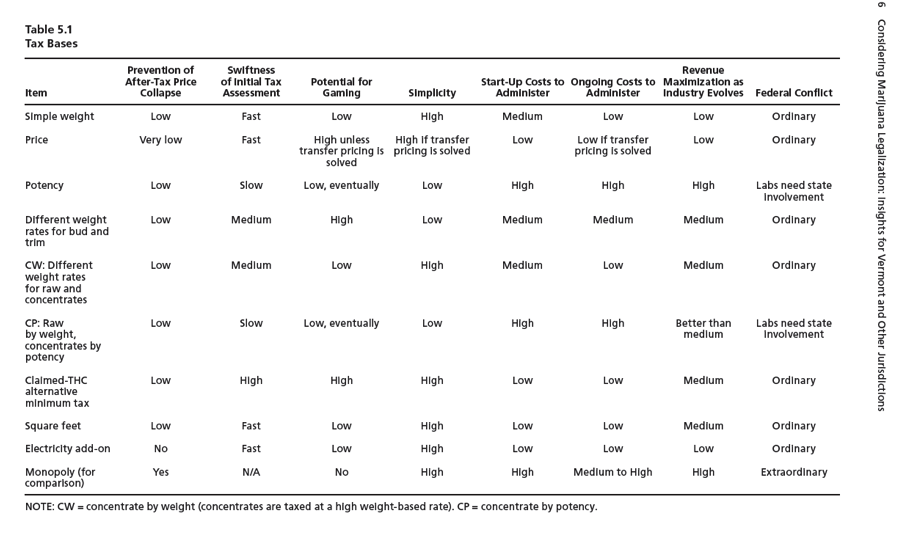
Click to see the entire chart, which examines various tax bases for cannabis — or go to page 86 of the RAND Report, Considering Marijuana Legalization: Insights for Vermont and Other Jurisdictions, http://www.rand.org/pubs/research_reports/RR864.html. That Report explains the conclusions that the chart reaches.
UPDATED May 24: “Seth Crawford, a marijuana policy researcher at Oregon State University, estimates the state grows three to five times the 150,000 pounds or so consumed by Oregon pot users,” writes journalist Jeff Mapes.
So shifting from a tax on producers to a “point of sale tax” at retail, described at https://newrevenue.org/2015/05/20/oregon-shifts-to-retail-percentage/, would leave the bulk of production tax-free, for export, right? No wonder growers don’t want to pay tax. Or am I missing something? UPDATE: A friend says I am: Continue reading “Collection point loophole?”
Preface by PO to the expert’s comments:
If you tax marijuana by canopy area – square feet of space under cultivation – you might be able to measure the area by aerial or satellite images. That comports with a principle of taxation – tax what you can measure. The RAND Report for Vermont says potency of raw flowers, and, in many cases, price, can’t be reliably measured. So canopy area has a lot of appeal as a tax base.
But those images won’t detect indoor cultivation. Here is some earlier discussion and criticism of an electricity tax aimed at singling out indoor growers. Meanwhile, more powerful batteries may make it harder for law enforcement to detect indoor grows – while reducing the environmental harm from those grows.
But if you want to collect tax on all commercially grown marijuana, what should you do?
I don’t necessarily agree or disagree with the following comments. But they help the process.
An expert in the industry has this to say:
“What would you do about indoor cultivation is levels and levels of tricky. This will take heavy lifting. Continue reading “Indoor grows and canopy tax — An expert comments “
Superseded by https://newrevenue.org/2015/05/26/oregons-wrong-direction/, link here.
Earlier iteration: See UPDATE May 25, near the end of this post, for a somewhat more developed analysis. Still thinking this through. THIS WILL CHANGE.
Jeff Mapes at the Oregonian writes:
SALEM—Oregon legislators on Monday unveiled a proposed retail sales tax for marijuana that would replace the harvest tax approved by voters.
The proposed sales tax was one of the major provisions included in a new 104-page amendment aimed at implementing the marijuana legalization initiative approved last November by voters. Continue reading “Oregon shifts to retail percentage? — Superseded”
Here are excerpts from a May 13 article by David Downs in the East Bay CA Express that I pass along without necessarily agreeing:
California 2016 legalizers must chose between angering the medical marijuana community with new regulations, versus gaining mainstream voters — who want to see the pot trade “controlled.”
. . .
“Most experts agree that California has among the least structured systems of rules Continue reading “Unresolved tension could fracture and kill CA reform efforts”

